Traditional Decor Style in Szekler and Saxon Homes
Traditional decor style here means Szekler carving beside Saxon painted rooms. See how Count Kalnoky Estates houses in Transylvania use both.
Traditional decor style in this corner of Transylvania means the furnishing logic of two neighbouring communities, Szekler and Saxon, rather than one European period, and it belongs to a global traditional interior-design segment valued at about US$33.19 billion in 2025. That same forecast projects the segment to reach roughly US$51.20 billion by 2033, a compound annual growth rate of 5.6% from 2025 to 2033.
Those figures come from a Grand View Research estimate of the traditional design-style segment, and they describe a working market rather than a museum wing. What a market forecast can't tell you is which tradition a given room belongs to. That's where most advice on this subject goes wrong.
The popular version starts with a palette, then a shopping list of antiques, then a mood. It produces rooms that photograph well and explain nothing. A house in Micloșoara or Valea Crișului wasn't furnished to a palette. It was furnished by people who needed storage, heat, seating and cloth that could be washed, and the two communities solved those problems differently: Szekler carving on gates, beams, chests and benches, and Saxon painted case furniture with floral panels on a darker or blue ground. Keep those two apart and everything else in the room starts to make sense.
What Traditional Decor Style Means Here
Traditional decor style, in this part of Transylvania, is the furnishing logic of a community's houses: how walls are finished, where the stove sits, which wood is carved and which is painted, and which textiles were made to be used rather than displayed. It isn't a European period you can date, and it isn't a shoppable old-world kit. It's a set of household decisions about heat, storage and work, and the ornament follows those decisions. Around Micloșoara and Valea Crișului, two of those sets meet: Szekler village rooms and Saxon town and village rooms.
Say a household has to store linen for six people, seat them at one table, and keep a single room warm through a Carpathian winter. That brief produces a bench with a lift-up lid, a painted chest against the wall, a tiled stove in the corner and a table pulled close to the heat. Nobody chose those pieces for a photograph.
Test any object against three questions before it enters a traditional room:
- Does it have a household job? Storage, seating, heat, light or washing. A piece that only decorates has to work much harder to justify itself.
- Does the motif belong to one tradition? A carved Szekler gate pattern and a Saxon painted chest panel come from different households with different histories. Mixing them for effect flattens both.
- Can the finish live with the building? Lime plaster, timber and masonry need to move moisture. A sealed, plasticised surface on a breathing wall is a repair bill in slow motion.
Catalogue styling often ignores all three. Crests, longcase clocks, gothic arches and unrelated folk symbols get assembled into one "heritage" theme, and the result reads as costume rather than place. Reporting on what buyers ask for now puts cultural heritage, artisanal craft and personal narrative near the centre of demand, as this Home Accents Today coverage of shifting design cues describes, which turns provenance into a practical question rather than a sentimental one. If you're buying rather than inheriting, start with makers whose joinery can be taken apart and repaired, and compare what you find against heirloom-quality traditional furnishings built to be reupholstered instead of replaced.
Count Kálnoky Estates is the setting where these rooms can be met in person: restored village houses are the accommodation, and castle rooms are gathering rooms, with the two kept separate. Which rooms can currently be booked is a question for the team, not for a web page.
Terms Used in This Guide
Nine words carry most of the argument that follows, so meet them once here.
- Szekler. The Hungarian-speaking community whose village houses and carved woodwork anchor the first column of the comparison below.
- Saxon. The German-speaking community of towns and villages, including settlements organised around fortified churches, whose furnishings sit in the second column.
- Lime plaster. A breathable wall finish made with lime rather than cement, which lets moisture pass through instead of trapping it.
- Hygroscopic. A word for materials such as timber, masonry, wool and linen that absorb and release water vapour as indoor humidity changes.
- Tiled stove. A heater of glazed tiles set into a room, often the main family room in Szekler houses.
- Case furniture. Chests, cupboards and dressers built as boxes, the pieces where painted or stained finishes usually appear.
- Biedermeier. A later, simpler furniture style of the early nineteenth century, sometimes found in Saxon households.
- Whitewash. A thin lime-based wash used on village house walls.
- Costume. A motif or prop, such as a crest or gothic detail, placed on a house where it didn't originate.
Rugs sit inside the same logic. A wool rug woven for a cold room is built differently from a decorative one, and Rubber Ducky Rug Cleaning Birmingham's guide to rug construction types explains the knotting and backing differences that decide how a piece wears underfoot.
Szekler and Saxon Furnishings Side by Side
Here are the two traditions in one view. Read the rows as habits rather than rules, then walk the prose underneath.
Szekler and Saxon rooms compared
| Trait | Szekler rooms | Saxon rooms |
|---|---|---|
| Building | Timber frames with whitewashed masonry in village houses | Thick stone or brick houses, often near a fortified church |
| Signature woodwork | Carved gates and beams with sun, moon, stars, tulips and rosettes | Structural timber kept plainer, with skill in chests and chairs |
| Furniture finish | Painted chests and benches with bright floral or geometric panels | Painted or stained case pieces, often floral on a darker or blue ground, sometimes later Biedermeier lines |
| Textiles | Embroidered runners, cushions and bed linen | Woven covers and orderly floral or striped cloth, used more sparingly |
| Heat | Tiled stove in a family room used through the day | Tiled stove or masonry heater in a more formal room sequence |
| Easy mix-up to avoid | Saxon crests or castle-gothic props | Szekler gate symbols used as loose decoration |
The building row sets everything else. A Szekler village house tends to be timber with whitewashed masonry panels, which is why carving sits on surfaces that a household could reach and maintain. A Saxon house in a village organised around a fortified church tends to be thicker stone or brick, and thick walls change what a room can carry: more mass, more formality, less exposed timber framing to decorate.
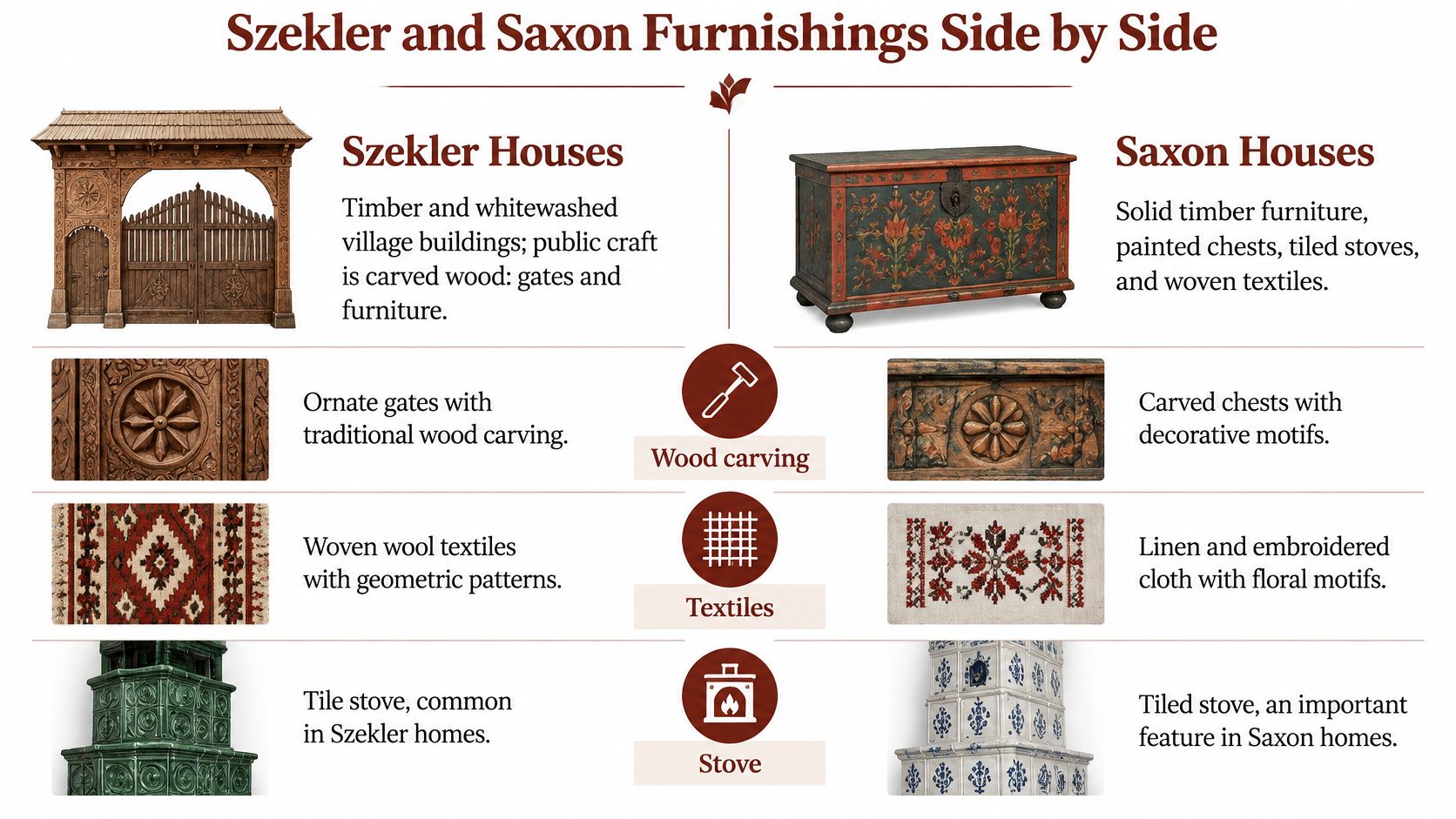
Signature woodwork is where the two part company most visibly. The carved gate is the public face of Szekler craft, a timber threshold carrying sun, moon, stars, tulips and rosettes, and the same vocabulary of cuts appears on beams, chests and benches indoors. Saxon structural timber stays plainer, and the skill shows instead in chests and chairs, where a maker's reputation rested on proportion, joinery and a clean painted panel.
Furniture finish follows that split. Szekler painted chests and benches often carry bright floral or geometric panels on a light ground. Saxon case pieces more often sit dark or blue, with floral work on top and, in some households, the simpler early nineteenth-century lines of Biedermeier. Neither is a later mood board. Both are movable wood, painted for a room rather than for a market.
Textiles and heat finish the picture. Szekler rooms layer dense embroidery on runners, cushions and bed linen. Saxon rooms use woven covers and orderly floral or striped cloth more sparingly, letting a room read as a sequence rather than a single layered space.
The mix-up to watch: a carved Szekler gate motif pinned onto a Saxon stone room, or gothic props added to either, reads as costume.
On a walk through Micloșoara or Valea Crișului, look for carving first, then for painted case furniture, then for how the stove relates to the room it heats. Not every house follows every row, and no visitor should expect a village to be a display case. If you want a wider frame for the same regional vocabulary, this piece on traditional cottage style sits close to the same material.
How Daily Use Shaped the Rooms
Start with the plan, not the objects. A traditional room is arranged around work and heat, not around a feature wall. In a Szekler family room the bench, table, painted chest and tiled stove share one space because eating, sewing, talking and sleeping all happened there. That's why the furniture looks dense: it's doing four jobs in one room.
Storage stays visible and repairable. A chest opens. A bench lifts. A textile comes off to be washed and goes back on. Furniture built to be opened, mended and moved has a different physical character from built-in joinery sealed to a wall, and the difference shows in how a room survives a century of use.
The room sequence in a Saxon house
A Saxon house often divides the same functions into a sequence: a formal room, a working kitchen side, and a cellar or vault for cool storage. That division explains why Saxon furnishing reads as a set of case pieces placed in a room, while Szekler woodwork includes the gate and the beam as part of how a household welcomes people in. One tradition puts craft on the threshold and the furniture. The other spreads craft across a plan.
What a visitor can notice without a guide
- The path from door to stove. Does furniture clear a route, or block it? Heat needed to be reachable.
- Where cloth sits. Textiles layered on beds and benches suggest a room used all day; cloth used sparingly suggests rooms used in turn.
- Where paint sits. Paint on movable wood can be repaired. Paint glued to a wall usually can't be.
- Whether anything is nailed shut. Anything that could be opened once was opened regularly.
Later reinterpretations belong in this picture rather than outside it. Nineteenth-century painted furniture and simpler Biedermeier lines arrived in these houses as fashion and as trade, not as mistakes, and a room that keeps them is more honest than one restored back to an imaginary single moment. The estate's own interiors carry that mixture too, in village houses used for stays and castle rooms used for gatherings, which is where these habits become something you can walk through.
Materials That Suit an Old House
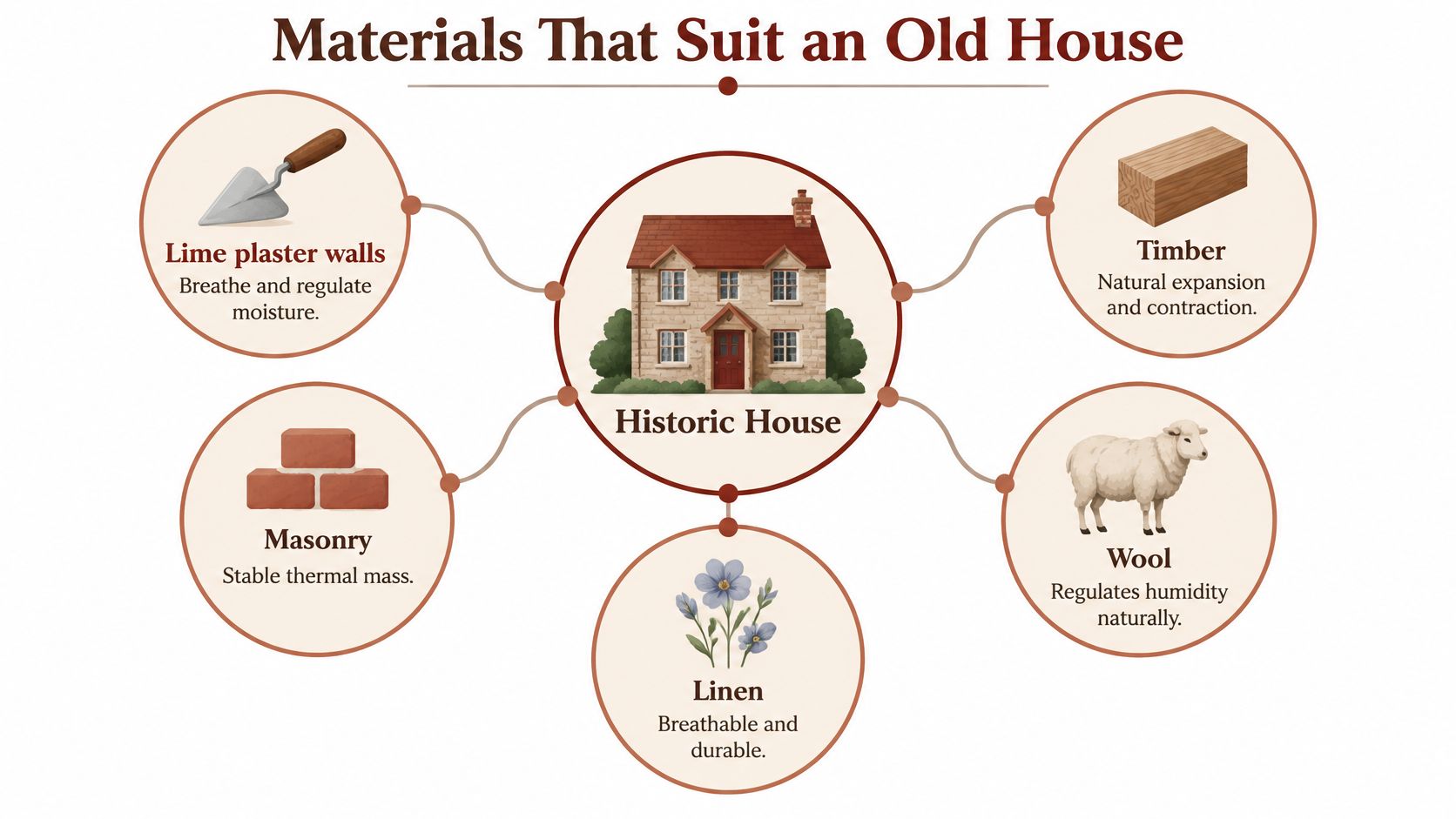
Think of a historic wall the way you think of a wool coat. Both take in moisture and let it out again, and both stop working if you seal them in plastic. Lime plaster, timber, masonry, wool and natural textiles absorb and release water vapour as humidity changes, and they work best with natural ventilation. Cover them with an impermeable finish and the drying pathway closes, moisture accumulates behind the decoration, and the damage appears where you can't see it.
Historic England's conservation research on energy efficiency makes the practical version of this point: characterise the existing wall and its moisture behaviour before any retrofit or refurbishment, then model long-term heat and moisture movement rather than guessing. The same guidance favours breathable coatings, interventions that can be reversed mechanically, furniture placed to keep air moving, and inspection access behind anything large and upholstered.
Judge a surface by how it handles vapour, not only by colour. The list below is a starting filter for a room where the old fabric matters.
- Work with lime. Lime-based paints and plasters, soft distempers, and clay finishes move with the wall instead of fighting it.
- Fix timber dry. Panelling on battens, loose furniture, and fixings that can be removed leave the wall inspectable and repairable.
- Keep cloth loose. Wool, linen and cotton hangings that can be taken down, washed and rehung behave very differently from a sealed wall-to-wall lining.
- Treat cement, vinyl and foil as risk. Cement-rich patching, vinyl coverings, foil-backed linings and many dense paint layers each reduce drying, and each can concentrate moisture where two materials meet.
- Leave inspection gaps. Don't press upholstery tight against a damp wall, and don't box in a beam or a fireplace opening that needs air.
Practical rule: if you can't describe how a finish dries, don't put it on a historic wall.
A modern material can look exactly right and still fail. Cement mortar is stiffer than lime mortar, a synthetic coating is less permeable than distemper, and a foil backing stops vapour outright, so joints and interfaces take stress the old substrate never carried. Cracking, staining, delamination and mould follow. This is also why a restored house shows plaster, timber and tile rather than a sealed hotel finish: the visible fabric is the building's ventilation system, not a shortcut around decoration.
For anyone copying the look at home, record each element before you buy a match: material, finish, approximate age, fixing method and cleaning limits. If a treatment for a historic room is uncertain, ask a conservator or the estate team rather than experimenting on the wall. A short guide to traditional cottage interiors shows the same palette in a domestic setting.
What to Keep and What May Change
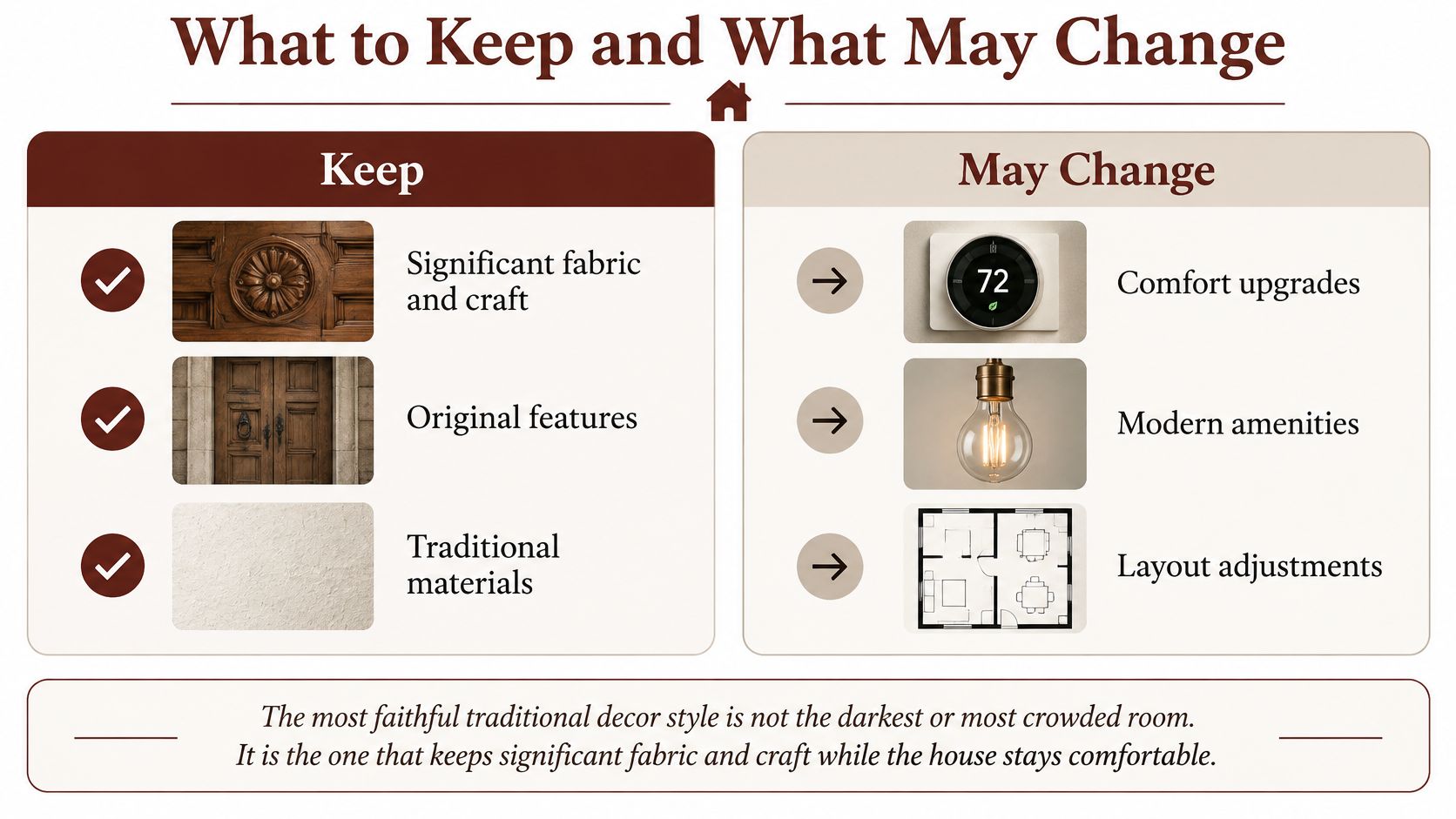
The most faithful traditional decor style isn't the darkest or the most crowded room. It's the one that keeps significant fabric and craft while the house stays comfortable, safe and usable. That's a judgement, not a style, and it's the opposite of what most guides imply when they treat authenticity as a test of how many antiques a room can hold.
Interest in the older look is measurable. Searches for vintage interiors rose from about 459,100 to 521,500 between May 2024 and April 2025, a 13.59% increase, according to design trend lifecycle reporting, which also notes a move toward long-lasting materials, vintage furnishings and artisan production. Rising curiosity isn't a reason to copy a trend into a house that can't carry it. It's a reason to decide carefully.
Keep or adapt in a traditional room
| Element | Usually keep | Change only with advice |
|---|---|---|
| Walls | Lime plaster and readable masonry | Cement-rich patches, vinyl or many dense paint layers |
| Wood | Carved or painted joinery repaired in place | Sealed composites fixed tight to damp walls |
| Furniture | Sound loose chests, benches and chairs | Pieces glued in or lined so walls can't be inspected |
| Textiles | Washable wool, linen and other loose natural cloth | Impermeable wall-to-wall linings |
| Daily comfort | Clear routes, useful light, a workable kitchen or bathroom | Alterations that hide the stove, beams or air paths |
Read the table as a filter, not a construction spec. The left column holds what you conserve: original plaster that still breathes, joinery with enough sound timber to repair, cloth that can be washed. The right column lists changes that need someone who understands the building, because each one can close a drying path or hide a problem until it's expensive. If you're mending a piece rather than replacing it, this guide to refinishing heirloom furniture covers the order of cleaning, stripping and re-finishing without destroying the surface you're trying to save.
Notice what this position rejects. It rejects the idea that guests should accept fragile antiques in a dark room with a difficult staircase, and it rejects the idea that comfort requires sealing everything. A castle room can hold rich fabrics and antique furniture and still host a garden gathering or a smaller cellar event, though which spaces are open and how they're arranged is a question the events team answers, not something to assume from an older page.
For a home reader the same table does one job before any purchase: if a reproduction can't be repaired and traps moisture, it's costume. That test settles more decisions than any colour chart.
Rooms at Micloșoara and Valea Crișului
A restored village house is the best place to see these habits working, because the rooms were built for the people who live in them rather than for a caption.
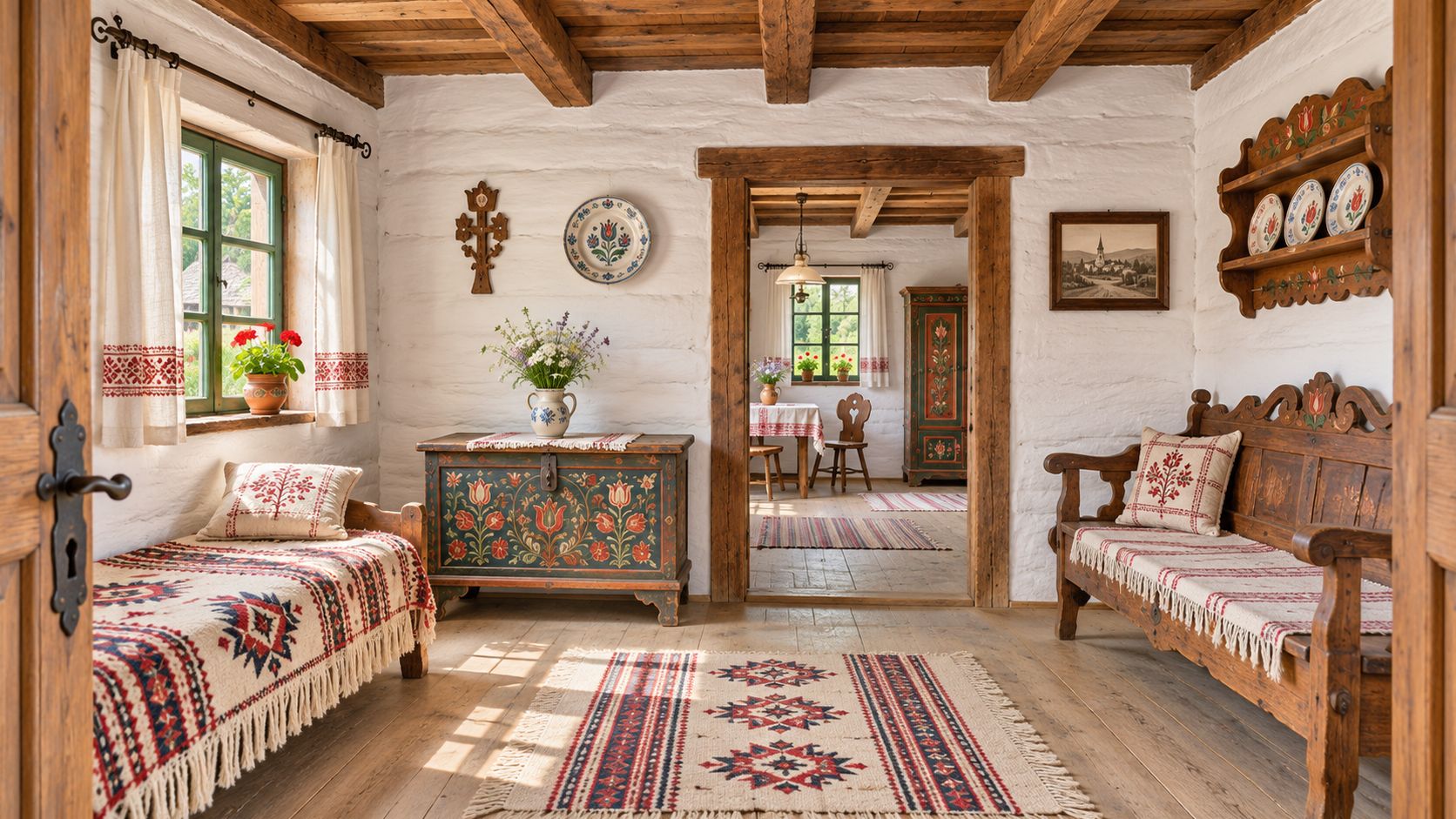
Village guesthouses and cottages in Miklósvár, that is Micloșoara, are the place to stay. They're restored houses furnished in the regional manner, sitting between the Saxon and Szekler country that shaped both traditions. They are not castle bedrooms, and a stay there shouldn't be described as one. Current village rooms and cottages are listed through the guesthouse accommodation pages, and availability changes with the season, so the team is the right source rather than any page you find secondhand.
Miklósvár Castle, also in Micloșoara, is a gathering place. Its events page describes five bedrooms with antique furniture, rich fabrics and the character of a historic family home, which is a description of a castle interior rather than a promise that anyone can sleep in it. Read it as the Miklósvár Castle events page presents it, then ask the events team before you assume a room is available for a stay.
Kőröspatak Castle in Valea Crișului offers a courtyard, historic interiors and a garden. Which spaces are open for a wedding or a private gathering is confirmed by the events team, and the Kőröspatak Castle venue page is the place to start that conversation.
The distinction matters practically. A couple planning a celebration may want nearby village accommodation for guests while the party happens in a castle room or the garden, and those are two different conversations with two different teams. Riding holidays across the hills around the estate are a third, separate activity, arranged through the accommodation side of the estate's site rather than through a castle booking.
If a photograph of a building appears in an estate listing, it shows that building. An illustration of a room is an illustration, not a photograph of a room you'll be given. When you look at carving, painted case furniture and the position of a stove, you're reading the same three checks that opened this guide, applied to a real house.
Ask the Right Team Before You Book
Two paths, and they don't overlap.
If you want to sleep in a traditionally furnished village house, start with the accommodation information on transylvaniancastle.com and ask the estate team what's currently open in Micloșoara. Riding holidays through the hills belong to that same accommodation side rather than to the castle bedrooms, so mention riding in the same enquiry if you want it. Count Kálnoky Estates runs restored village houses as guest accommodation and riding across the surrounding countryside as a separate activity, as the main estate site sets out, and the accommodation service is where both are confirmed.
If you want a wedding, anniversary or other private gathering, use the events enquiry first, then the venue page you have in mind, either Miklósvár Castle in Micloșoara or the Kőröspatak Castle page for Valea Crișului. The wider events programme sits alongside those pages, and public concerts are listed separately on the events calendar, which is not a wedding route.
A personal offer is the right way to learn what's included. Venue hire amounts, supplier rates and deposits aren't things to gather from an article, and the team would rather answer a direct question than have you plan around a number you read somewhere.
Traditional decor style on these estates is Szekler and Saxon furnishing in real houses, with village guesthouses for staying and castle rooms for gatherings when the team confirms them. Look again at the carving, the painted furniture and the stove, then write with the house and the dates you have in mind.
Count Kálnoky's Estates keeps restored village houses in Micloșoara for guests, furnished in the Szekler and Saxon traditions this article describes, and opens castle rooms for weddings and private gatherings in Micloșoara and Valea Crișului. If you'd rather sleep among carved beams, painted chests and tiled stoves than read about them, the team can tell you what's currently open and what a stay or a celebration would include. Visit Count Kálnoky's Estates to see the houses and send your dates.