Traditional Cottage Decor in Szekler Houses
Traditional cottage decor explained with Szekler and Saxon materials, breathable walls, and Count Kalnoky village stays.
The most popular advice about traditional cottage decor starts with shopping: add floral fabric, distress a cupboard, collect antiques. In a Transylvanian village house, start with the building instead. A painted chest won't make a room authentic if its walls can't dry, and an old floor doesn't need a new covering to look finished.
What Traditional Cottage Decor Means Here
Say you're furnishing a compact room near Micloșoara. The tempting approach is to choose a cottage-style furniture collection, then fit the house around it. The more useful approach is to examine the plaster, floorboards, window openings and existing furniture before adding anything.
Vernacular furnishing follows the place where people built and lived. Thick masonry or timber, lime finishes, handmade textiles and repairable wooden furniture belong together because they answered practical household needs, not because someone designed them as a matching scheme.
Szekler and Saxon domestic traditions
In Szekler village interiors, look for painted chests, woven covers, limewashed surfaces and compact rooms arranged for daily use. Saxon village and small-town traditions often read through ordered carpentry, tiled heating and durable household goods kept carefully over time. These are useful distinctions, not rigid labels for every house or object.
Both traditions can look modest without being sparse. A bench might provide seating and storage; a woven cover might supply the room's strongest colour. For a broader introduction to furniture categories, Guynn Furniture & Mattress helps readers compare cottage and urban furniture, though local materials and construction remain the better guide here.
Start with the house: Choose furnishings that suit its scale and construction, rather than making the building imitate a decorating style.
Count Kalnoky Estates separates restored village houses for staying from its historic event settings: Miklósvár Castle in Micloșoara and Kőröspatak Castle in Valea Crișului. That distinction matters when planning a Romanian holiday or destination wedding. Present-day comfort can mean discreet heating, good lighting and comfortable bedding without turning an old house into a sealed modern shell.
Judge each material by its purpose, repairability and effect on drying. Then decide whether you want a guesthouse night or a celebration in a castle setting.
Materials That Make a Transylvanian Cottage Interior
Szekler and Saxon cottage materials
| Element | Regional reading | How it should behave | Avoid |
|---|---|---|---|
| Limewash or lime plaster | Shared village wall finish | Vapour-open mineral surface that can dry | Acrylic paint or a cement skim |
| Painted wooden chest or bench | Strong Szekler household piece | Solid, repairable wood used in the room | Flat-pack rustic furniture fixed to a damp wall |
| Ordered joinery and a tiled stove | Often a Saxon or small-town reading | Durable carpentry and contained radiant heat | A fake stove or sealed modern fireplace insert |
| Linen, hemp or wool textiles | Shared village craft | Washable layers with air behind them | Synthetic carpet and plastic-backed wallpaper |
| Handmade ceramics | Regional table and storage ware | Everyday vessels, not unused props | Mass-produced rustic ornaments |
| Beams and floorboards | The building itself | Visible, repairable, ventilated timber | Vinyl or laminate over historic boards |
Read the finish before choosing the colour
Limewash and sound lime plaster provide a mineral background rather than a flawless decorative skin. Warm off-white, soft grey or muted earth tints let slight surface irregularities remain visible. Pair these walls with a restrained reading lamp, positioned to light a chair or book rather than conceal the room behind elaborate fittings.
A painted wooden chest or bench introduces a different kind of detail. Look at its construction, hinges, repairs and wear before its flowers or geometric bands. A useful chest can hold fresh bedding beside a comfortable modern bed; it doesn't need to become an untouchable display.
Ordered joinery and a surviving tiled stove suggest another domestic emphasis: careful carpentry, storage and contained heat. Preserve those relationships rather than installing a decorative imitation stove. If supplementary heating is needed, have its position and installation assessed so it doesn't damage furniture, finishes or the existing heating structure.
Keep household materials in use
Linen, hemp and wool provide removable layers. Check the care requirements of each textile, especially if it's old, rather than assuming every woven cover can go into a washing machine. Pair a sturdy runner with an uncluttered contemporary table setting, and keep fragile textiles away from everyday spills.
Handmade ceramics make sense as tableware and storage vessels. Use pieces known to be suitable for food for serving, and keep uncertain antique glazes for non-food purposes. A simple modern tray can protect a wooden surface beneath a jug without hiding the furniture.
Beams and floorboards aren't accessories. They're building fabric, so repairs should come before cosmetic uniformity. A good mattress supplies bedroom comfort without requiring the historic floor beneath it to disappear.
These choices belong to a much broader building history. UNESCO's account of vernacular traditions describes locally shaped architecture ranging from Finnish wooden cottages to earthen houses across several continents. Cottage character isn't an exclusively British look, and natural surfaces aren't a recent invention.
An object belongs when it has a regional job, can be repaired, and leaves the wall and floor able to dry.
That test is more useful than asking whether everything looks old. A plainly made new lamp may pass it more convincingly than a mass-produced cupboard with artificial wear.
How Walls Floors and Textiles Should Breathe
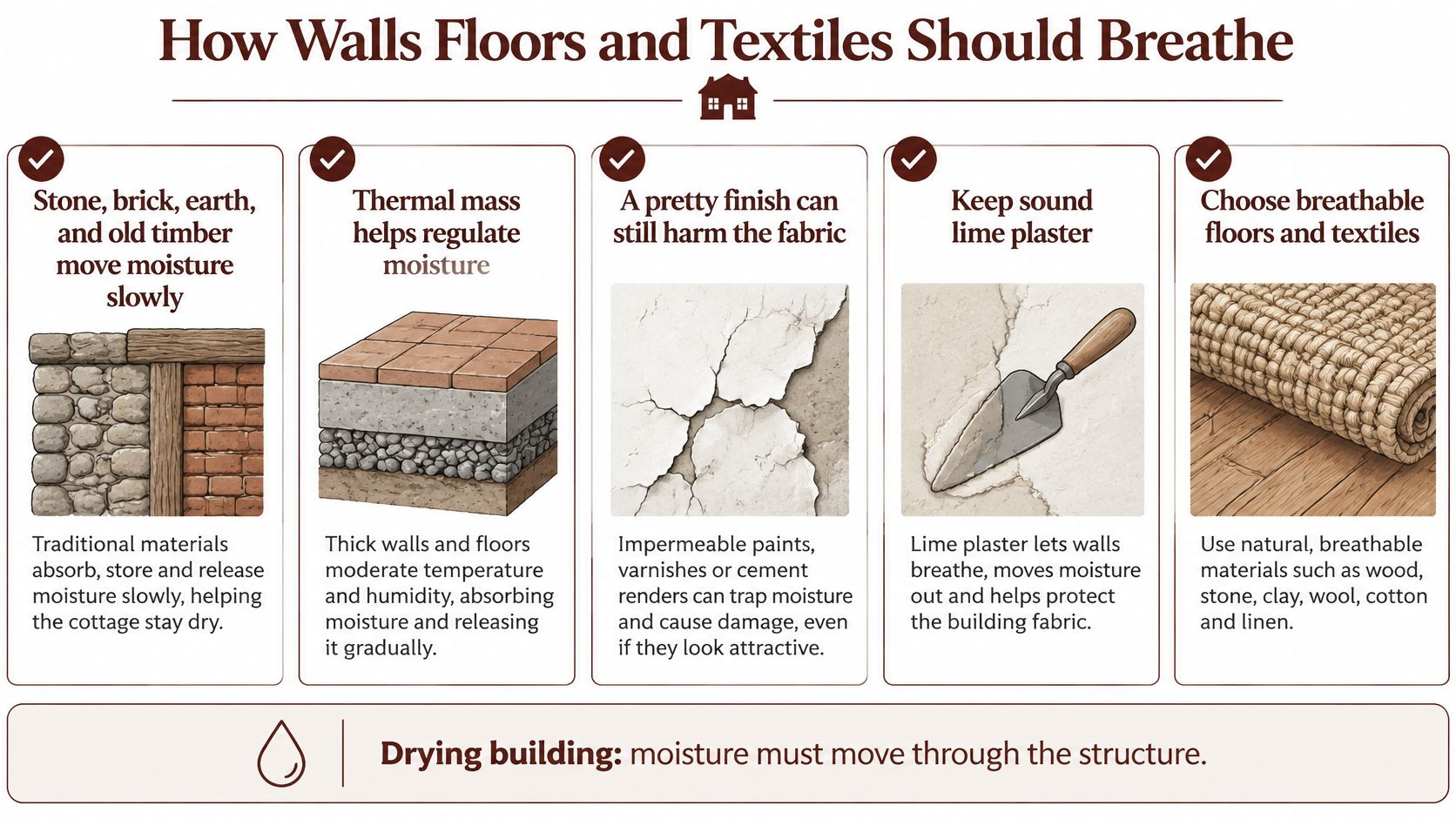
A beautiful finish can still harm an old cottage. Stone, brick, earth and old timber absorb, transport and release moisture at different rates. Thick masonry also stores heat, but thermal mass isn't a substitute for ventilation, drainage or appropriate heating.
Think of the cottage as a drying building, not a perfectly sealed container. Breathability describes moisture movement through materials and surfaces; it doesn't mean accepting uncontrolled draughts.
This checklist illustrates the relationship between the building fabric and its finishes.
Keep moisture routes open
Lime plaster is vapour-permeable and hygroscopic: it takes up moisture as indoor humidity rises and releases it as conditions dry. Research discussed in a study of lime-plastered traditional buildings associates hygroscopic materials combined with controlled ventilation or HVAC with approximately 30% less heating demand and 5% less cooling demand, not a guaranteed saving for an individual Transylvanian house.
Lime isn't automatically mould-proof. Persistent damp and organic additives can still support mould, so painting over a stain doesn't resolve its cause.
Follow this maintenance sequence before restyling:
- Stop incoming water. Repair roof defects, gutters and ground drainage before buying finishes or furniture.
- Retain sound plaster. Keep compatible lime wall and ceiling finishes wherever they remain serviceable.
- Allow air behind furnishings. Leave a ventilation gap behind large chests, wardrobes and heavy textiles against external walls.
- Keep floor coverings removable. Prefer suitable natural-fibre rugs that can be lifted for cleaning and inspection over vinyl or wall-to-wall synthetic carpet.
- Assess insulation before installation. A vapour-open, capillary-active proposal still needs a hygrothermal check of the wall, exposure and heating pattern.
- Inspect concealed areas. Watch corners, window reveals and hidden timber instead of covering discolouration.
Improve comfort without trapping damp
An old wall can become colder behind poorly designed internal insulation. Historic England's energy-efficiency research examines how changes to traditional roofs, walls, floors and windows affect both energy performance and indoor conditions. A suitable upgrade therefore starts with the existing construction, not a universally prescribed product.
The accompanying video offers another way to approach the subject.
For owners, a room hygrometer and a record of recurring damp patches can help identify patterns worth investigating. For visitors, the useful question is simpler: ask the estate team how the particular restored house is heated and ventilated. No general account of cottage construction replaces the building in front of you.
Mixing Inherited Pieces With Quiet Modern Comfort
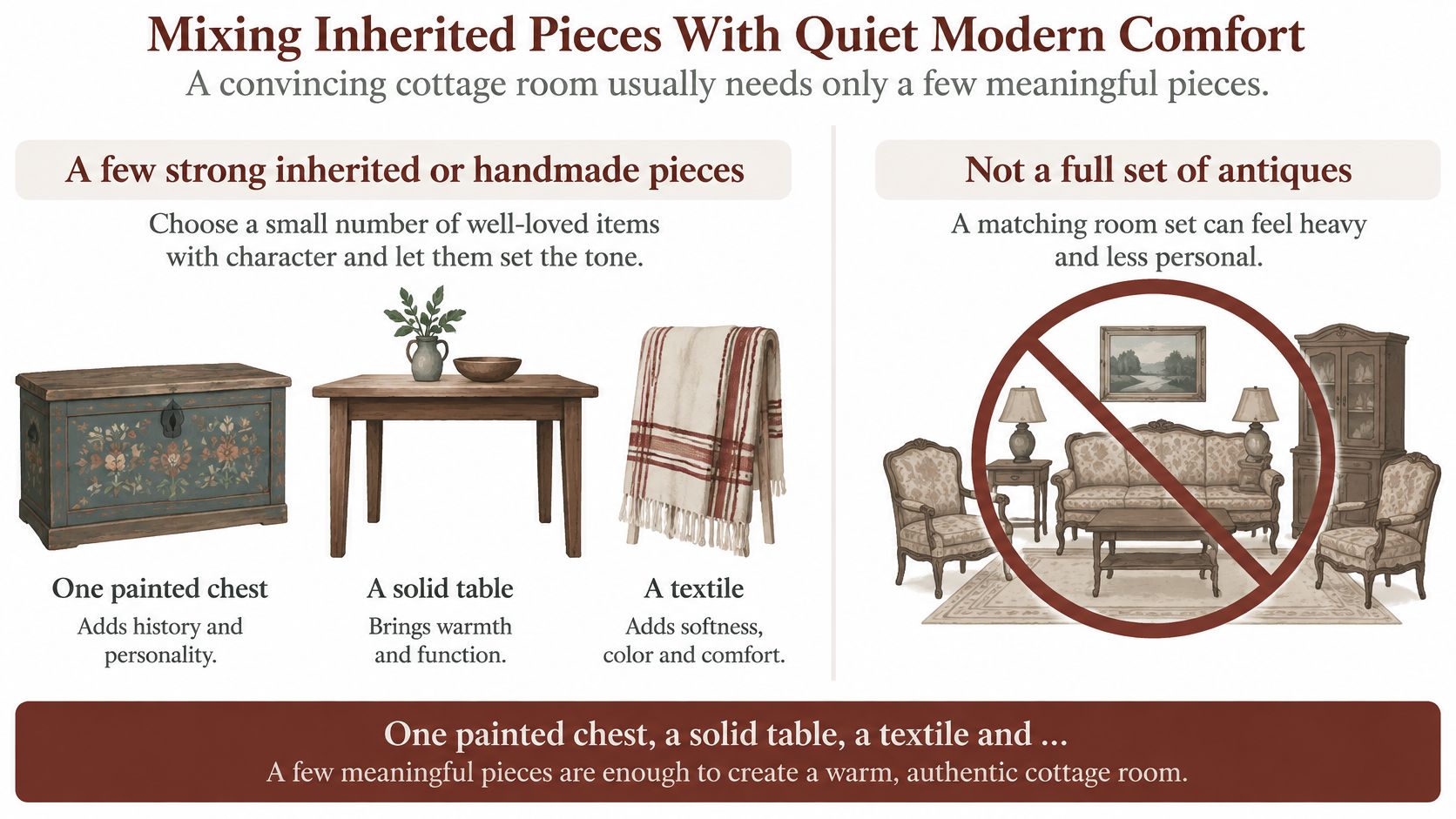
A convincing cottage room usually needs a few strong inherited or handmade pieces, not a complete set of antiques. A painted chest, a solid table, a textile and useful ceramics can establish the domestic character when the underlying finishes are appropriate.
There's no meaningful antique quota. A room has too many precious objects when guests can't put down a glass, open a drawer or sit comfortably without worrying about damage.
The distinction is between useful furnishing and a room arranged only for display.
What the interest in vintage actually supports
Design reporting published by the Watauga Democrat says 85% of surveyed designers were incorporating vintage pieces and use of genuine pre-1920s antiques rose from 56% in 2024 to 63% heading into 2026; it also cites a separate 2025 consumer survey in which 52% considered sustainability somewhat or very important and 64% of those respondents would pay more for sustainable products.
Those findings support an interest in combining old and new, not a requirement to buy antiques. Locally, the stronger principle is to repair an appropriate regional piece rather than remove a scarce original from its setting to decorate another room.
Document what you know about an object: maker, place of purchase, previous ownership and repairs. Don't turn an uncertain origin into a confident village history.
Give each addition a practical reason
A reproduction can be the responsible choice when daily use would damage an original. Identify it openly as a reproduction, and choose sound construction rather than theatrical ageing. Safe wiring, a good mattress, a simple lamp and a discreet appliance don't invalidate traditional cottage decor.
Useful decisions include:
- Protect vulnerable furniture. Place a washable mat beneath a water jug and use a separate surface for hot appliances.
- Keep contemporary fittings quiet. Choose a lamp for its light and proportions, not because it imitates an antique.
- Buy for continued use. Check whether a chair can be repaired and whether a textile can be cared for realistically.
Farmhouse World's rustic-meets-modern room styling rules offer a broader mixing reference. For regional context, the estate's guide to traditional furniture styles helps keep the discussion connected to the furniture rather than a generic rustic look.
Renters and city homeowners can apply the same judgement through a well-made textile or ceramic. There's no need to buy disposable rustic props or imitate historical hardship. Rural rooms were working rooms; present-day comfort should be provided plainly, not apologised for.
Restored Village Guesthouses at Count Kalnoky Estates
Village stay or castle setting
| Question | Village guesthouse | Castle space |
|---|---|---|
| Main purpose | Sleeping and living in a restored village house | Weddings, private gatherings and celebrations |
| Where it sits | Count's Guesthouses in Micloșoara; King's Retreat is separate at Valea Zălanului | Miklósvár Castle in Micloșoara; Kőröspatak Castle in Valea Crișului |
| Decor to expect | Traditional domestic furnishings in a cottage-scale house | Historic interiors and grounds arranged for an occasion |
| How booking works | Accommodation through the accommodation website, subject to availability | Events through the events service; a celebration doesn't include a castle stay |
| What to confirm | Exact house, arrangement and dates with the team | Spaces and layout for the date; no universal guest number |
Choose the property before choosing the room
The official estate overview describes the Count's Guesthouses as heritage accommodation on the estate, while Miklósvár Castle appears separately as an event venue. For travellers who want cottage interiors as somewhere to sleep and spend time, the village houses are the relevant starting point.
A castle hired for a celebration works like a village hall booked for the day: the occasion fills the rooms, then the guests go home to sleep elsewhere. A castle photograph shows a setting, and a wedding reservation confirms the celebration spaces. Neither establishes a bookable bedroom, so keep the accommodation discussion attached to the named house and its current room arrangement.
Naming causes the next confusion. The King's Retreat, also known as the Prince's Retreat, is a rural stay at Zalánpatak / Valea Zălanului in the Carpathian foothills. It shares a wider travel offering with the Micloșoara houses, yet it sits in a different village and shouldn't be described as a Micloșoara cottage. Kőröspatak Castle belongs to the events discussion, so treat any overnight question there as an enquiry for the team rather than an assumption about castle rooms.
Before reserving: Ask for the building's name and location rather than relying on a room category or an attractive photograph.
Read photographs as property information
Current accommodation photographs earn their keep at domestic scale. Study the relationship between bed, table, storage and window: how a person would dress, read and put things away in the room. Traditionally finished walls, wooden furniture and textiles are useful details to notice, although no single photograph guarantees the inventory of every room in the house.
Check that each photograph identifies the property shown. Drawings and mood imagery explain principles of cottage decor; a named, dated interior photograph is the only evidence of a specific room's furnishings or facilities.
Begin with the guesthouse rooms information, then send the team a practical description of your stay: who is travelling, your dates and any requirement that decides whether a particular house suits you. Ask about the exact arrangement instead of assuming separate bedrooms, a particular bathroom layout or specific dining provisions.
For wedding guests, nearby village accommodation is a separate availability question. Establish who will coordinate room enquiries and whether each household needs to book directly. An itinerary built around unconfirmed rooms tends to unravel.
Accommodation, riding and countryside-tour information belong with the travel team on the accommodation website. A useful booking conversation ends with a named building, a confirmed arrangement and a clear account of what is included. Agreement on a picturesque setting is where that conversation starts.
Plan the Celebration and Confirm the Booking
A destination wedding introduces different questions from a cottage stay. The setting must support the sequence of the day: where people gather, where they eat, how the celebration moves between spaces and what happens if the intended outdoor arrangement can't be used.
At Micloșoara, the official Miklósvár event description identifies a ceremony beside the pond, drinks in the courtyard, dinner and dancing beneath a tent, and smaller gatherings beneath stone vaults. It also describes the courtyard tent as a setting used for dinners, speeches and dancing.
Match the spaces to the gathering
These are named settings, not a promise that every combination will be available for every date. Capacity and layout follow the event plan and need confirmation from the team. Ask how the proposed ceremony, meal and evening gathering fit together before planning decorations or commissioning printed schedules.
Cottage character can sit comfortably around a castle celebration without pretending the castle is a village bedroom. If you choose linen table coverings, wooden details or handmade tableware, treat them as practical styling proposals for approval. Don't assume they're estate inclusions.
At Kőröspatak Castle in Valea Crișului, the identified features are a courtyard, historic interiors and a garden. The events team should confirm which spaces suit the date and gathering. Keep questions about access, services, suppliers and weather alternatives attached to that specific proposal rather than transferring assumptions from another venue.
A restrained plan also respects the historic fabric. Ask before fixing decorations to plaster, hanging textiles, moving furniture or placing candles near old timber. Freestanding arrangements are proposals too, not automatic permission.
Choose the stay route or the event route
For a night in the decor, contact the accommodation team through the travel website. Explain your dates and party, and ask whether a Micloșoara village house or the separate Valea Zălanului retreat better fits the visit. Confirm what's included and how the proposed house is heated.
For a wedding, anniversary or private gathering, start with the weddings and private events service and submit a personal event enquiry. Name Miklósvár Castle or the Valea Crișului venue, give the season or preferred dates, and describe the kind of gathering. Request a personal offer rather than relying on a general price or assumed package.
Keep guest rooms separate from the venue enquiry until the accommodation arrangements are confirmed. Public concerts follow another route altogether and belong in the public events calendar, not the private-event booking process.
Include these questions in either kind of enquiry:
- Which building is available? Ask for its name and location for your intended dates.
- What does the booking include? Establish the particular rooms or event spaces and any separately arranged elements.
- Which traditional interiors will we encounter? Ask which finishes, furniture or domestic spaces belong to the property being proposed.
The answers let you plan around an actual house or venue rather than an impression assembled from several properties. They also leave room for the qualities that make the visit worthwhile: a usable village interior, carefully maintained materials and a celebration suited to its historic setting.
Count Kalnoky Estates offers restored village guesthouse stays and separate historic settings for weddings and private gatherings in Transylvania. Visit Count Kálnoky's Estates to explore a stay rooted in traditional domestic interiors, then ask the team which house suits your dates or request a personal event offer through the events service.