Traditional Furniture Styles in Transylvanian Houses
Traditional furniture styles explained through Saxon and Szekler pieces, with a field guide to restored Transylvanian guesthouse rooms.
The usual advice about traditional furniture styles is to choose a period and make everything match. That's a poor starting point for a Transylvanian house. A painted chest, a plain wooden bench and a more formal bed can belong together without sharing a date or decorative language. What matters is how they were made, how people used them and whether their place in the room makes sense.
In Transylvania, Romania, that means distinguishing regional household traditions from the broader European styles that influenced formal interiors. It also means looking carefully without claiming more than an object can tell you. A floral panel is a clue, not a certificate of origin.
Field Guide to Traditional Furniture Styles
How to recognise traditional furniture styles
| Style | Era or origin | Materials and construction | What to look for | Transylvanian setting |
|---|---|---|---|---|
| Szekler vernacular | Village craft of the Szekler region | Solid wood, carved frames, handmade casework | Geometric and floral carving, chests, benches, low storage | Village houses and cottage rooms |
| Saxon Transylvanian | Saxon town and village households | Painted pine or oak, framed chests | Floral painted fronts, dowry chests, sturdy tables used with textiles | Saxon town and village rooms |
| Renaissance | Italian Renaissance | Framed panels, symmetrical casework | Balanced proportions, panels, classical profiles | Formal historic rooms rather than everyday cottage furnishing |
| Baroque | European courtly and formal household traditions | Heavy carved wood, sometimes gilded | Curves, dense ornament, formal display | Formal display rooms rather than plain village houses |
| 19th-century revival | Earlier Gothic, Renaissance, Rococo or Neoclassical forms reinterpreted | Handmade luxury pieces and later factory goods | Familiar period features made for newer households | Mixed historic interiors where dates don't match one style |
| Arts and Crafts | British and American craft reform | Solid wood, exposed joinery, honest materials | Visible construction, restrained ornament, little historicist copying | Handmade rural character for comparison |
These rows describe features to look for, not dated objects in any particular guesthouse. They also compare different kinds of categories: Saxon and Szekler describe regional traditions, while Renaissance and Baroque describe wider historical styles. Arts and Crafts is useful as a comparison, not as a default label for any plainly made Transylvanian chair.
The World Collectors Net account of Arts and Crafts places the movement's height at approximately 1880 to 1910 and notes the Victoria and Albert Museum's broader dating from 1880 to about 1920. Its emphasis on craftsmanship, honest materials and visible making helps explain why a restrained piece can be traditional without being lavishly decorated.
Check construction before decoration
Start with the object's underlying form. Does a cupboard have a frame around separate panels? Is the ornament cut into the wood, painted onto it or attached as additional moulding? You don't need to identify every joint to notice that decoration and construction are different kinds of evidence.
Then ask what the furniture did. A chest intended to hold household textiles has a different role from a cabinet made to display possessions. Calling both ornate storage misses the distinction between daily domestic use and formal presentation.
Finally, consider cultural fit before mixing. A piece may suit a room because its scale, materials and use belong there, rather than because its colour matches the curtains. Age or price alone doesn't prove authenticity, and an old object isn't automatically appropriate to every historic interior.
Practical rule: Treat a style label as a starting hypothesis. Construction, household use and provenance should support it.
For a broader decorating perspective, Tip Top Furniture & Mattresses' timeless furniture design ideas offer a useful comparison with contemporary interpretations of traditional interiors. Keep that decorating approach separate from identifying regional heritage: arranging a comfortable room and establishing an object's cultural history are related, but they aren't the same task.
How Period Styles Layered into One Room
Traditional furniture developed through successive periods, not through a single design rule. The Illinois State Museum's historical furniture survey traces European developments through the Italian Renaissance of the 14th and 15th centuries, ornate 17th-century Baroque, and the revival styles of the 19th century. That sequence helps explain why familiar historical features can appear together without belonging to the same original moment.
Renaissance makers developed furniture with an emphasis on order, panels and classical proportion. A balanced cupboard front can convey formality through its arrangement alone. The effect doesn't require a surface covered with decoration.
Baroque furniture offered another approach. Carving, curves and gilding could turn a furnishing into part of a larger display of status. Those qualities make more immediate sense in a formal household or castle room than beside the working furniture of a modest cottage.
Older forms for newer households
Revival makers later reinterpreted Gothic, Renaissance, Rococo and Neoclassical ideas for different customers. Production also changed, from individually commissioned furnishings to manufactured goods for a broader market. A carved profile therefore tells you about a design reference, but not necessarily when or how the whole object was made.
Arts and Crafts makers challenged that appetite for historical imitation by directing attention towards materials and making. The important contrast wasn't ornament against plainness. It was also whether the construction itself deserved attention, rather than disappearing behind a borrowed historical appearance.
A traditional room is a stack of household decisions rather than a costume from a single period.
Apply that idea cautiously in Transylvania. Say a village room contains a painted chest, a later bed, a tiled stove and plain plaster walls. That combination could reflect a household keeping useful possessions while changing other parts of its domestic life. It needn't be an error that a restorer should correct by making everything match.
The qualification matters: a plausible explanation isn't a documented object history. Without an inventory, maker's record or reliable provenance, don't assign the chest a date or invent the family that owned it.
Continuity is more than a copied motif
A decorator can copy a flower from a photograph and reproduce its outline accurately. That alone doesn't preserve the knowledge behind the original piece: timber selection, preparation, construction, painting technique or household meaning.
A restored room can mix periods when those differences remain understandable. The regional distinction between Saxon painted furniture and Szekler carved furniture gives the reader a more useful starting point than a demand for visual uniformity.
Saxon and Szekler Furniture in a Village Room
Saxon and Szekler furnishings shouldn't be treated as interchangeable rustic decoration. Both can belong to domestic interiors in Transylvania, but their characteristic surfaces, construction choices and household roles deserve separate attention. Use the distinction to ask better questions, not to attribute every object by appearance.
The diagram below presents broad recognition clues rather than authenticated examples from an estate collection.
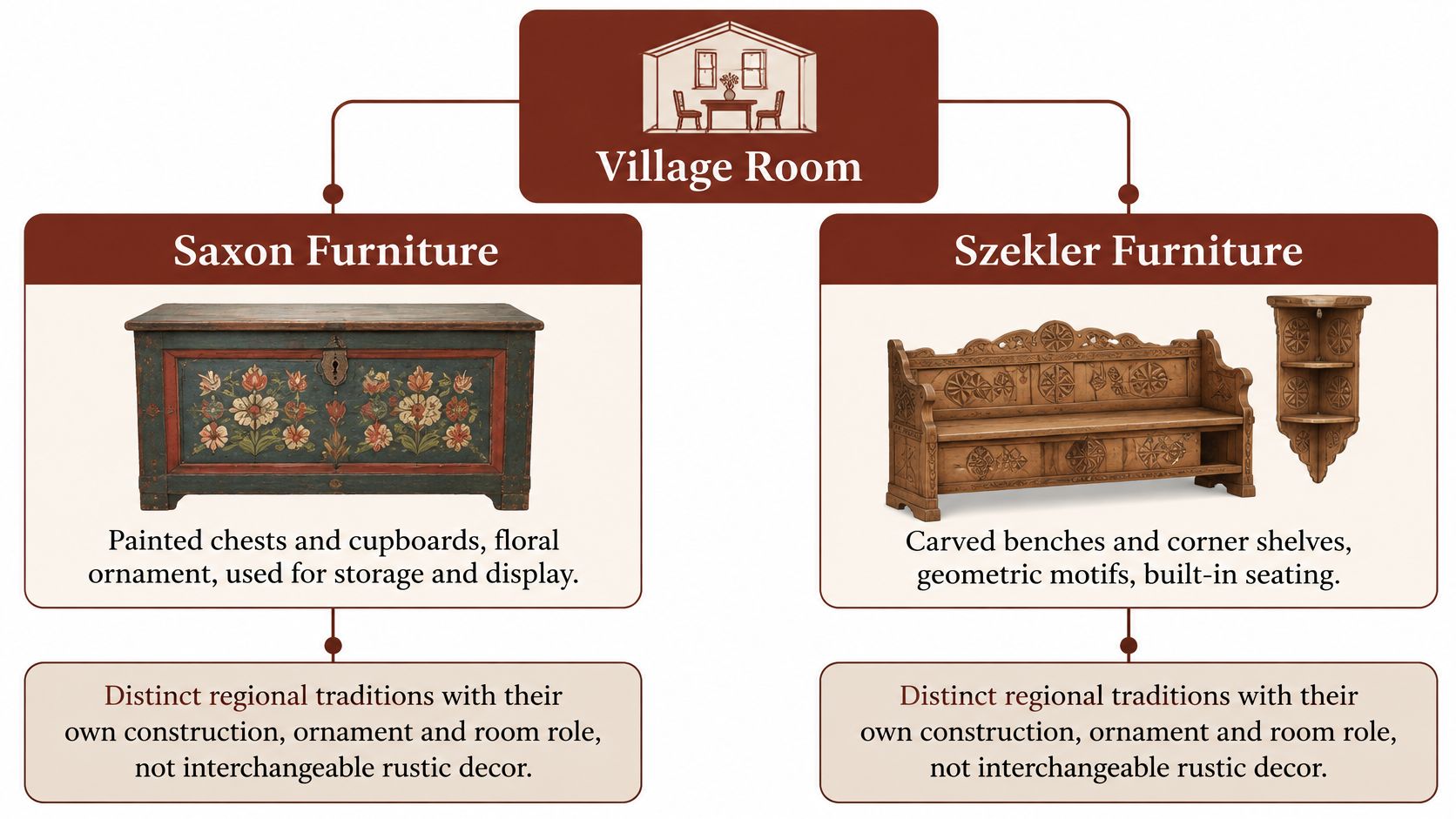
Painted storage and carved household furniture
For Saxon furniture, the household chest offers a useful starting point. Look for painted fronts, floral ornament and a substantial storage form associated with keeping textiles. Read the chest alongside cupboards, tables and fabrics, rather than treating its painted face as a detachable artwork.
For Szekler furniture, begin with carved wood and the relationship between structure and folk ornament. Geometric patterns or plant motifs may appear on chests, benches and strong wooden frames. Corner seating and compact storage also direct attention to the practical organisation of village life.
Neither description is an exclusive test. Flowers aren't confined to painted furniture, and carving doesn't establish a Szekler origin by itself. Timber species can also be difficult to identify under paint or a dark finish, so don't confidently call a piece oak or pine from a distant photograph.
Read the whole room
Use this three-part reading method without opening or moving anything:
- Look at structure. Is the piece a chest, bench, table or bed made for daily work? Notice its proportions, supports and relationship to the floor.
- Look at ornament. Separate painted floral surfaces from carved geometric or plant motifs. Consider whether the decoration follows the frame or sits within a panel.
- Look at the room. Oak beams, plaster, textiles and a tiled stove provide the context that makes the furniture legible.
A floral paint scheme or carved panel may represent a continuing craft tradition, a revival interpretation or a recent heritage-style furnishing. Leave an unnamed object undated until someone with reliable records can identify it.
The European Commission's antiques-consumption project report connects engagement with antiques to cultural practices, second-hand habits and early exposure. That's a useful reminder that understanding old furniture isn't reserved for collectors with expensive acquisitions.
Mixing traditions can support preservation when each object retains its construction, identity and story. Borrowing becomes harder to defend when makers strip motifs of context and apply them only as a decorative theme.
For the surrounding architecture, the guide to traditional cottage style offers a complementary way to consider the room. During a stay, notice visible panel edges, painted borders and the position of seating. Ask about provenance rather than lifting lids, testing drawers or examining the underside of an antique.
Joinery and Wood Movement in Traditional Furniture
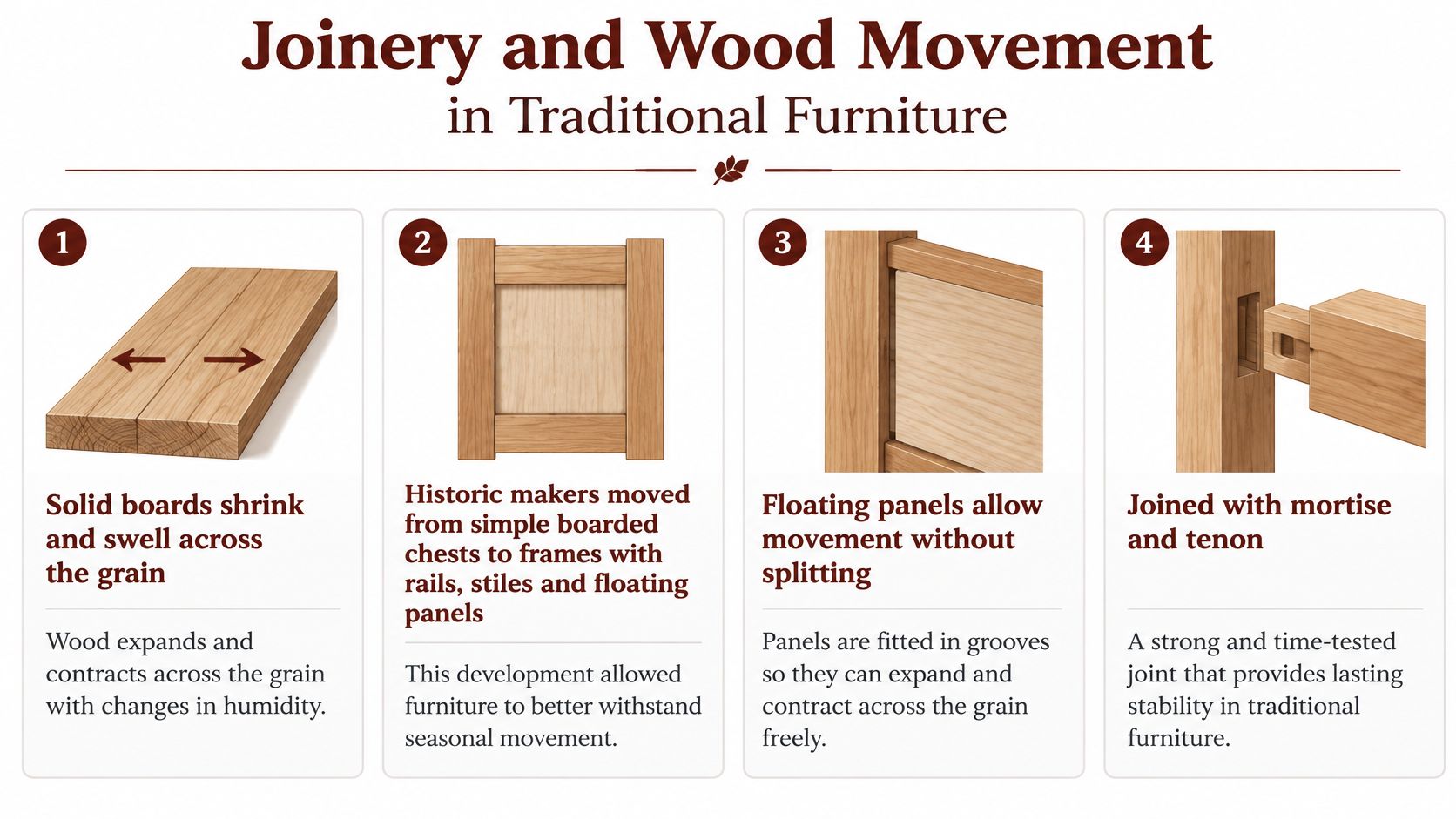
A furniture maker must allow wood to change size as it exchanges moisture with the surrounding air. Solid boards shrink and swell across the grain, which makes a broad panel a structural problem as well as a decorative surface. The Smithsonian Museum Conservation Institute's furniture guidance explains why framed-and-panelled construction, suitable joints and careful treatment of veneers matter to long-term stability.
Think of a panel as a picture held within a frame, but not glued immovably around every edge. Rails form the horizontal members and stiles the vertical members. A floating panel sits in grooves within them, allowing movement without forcing the whole assembly apart.
The diagram illustrates that construction principle.
What the joints do
Mortise-and-tenon joints connect frame members by fitting a projecting tenon into a corresponding socket. Dovetails help resist a drawer or case being pulled apart and provide mechanical resistance to distortion. Neither should be treated merely as a decorative sign of quality.
Veneer deserves equally careful judgement. It isn't automatically evidence of inferior furniture: a correctly bonded veneer can provide a stable decorative surface. Poor environmental conditions or failed bonding, however, can leave it lifting or separating.
For restoration, match the timber species where appropriate, preserve meaningful hand-tool evidence and avoid repairs that lock broad panels against movement. More adhesive isn't necessarily a stronger repair if it prevents the construction from working as intended.
Handling in occupied heritage rooms
The guidelines for historic furnished interiors treat furniture as load-bearing construction, not decoration. For trained staff arranging guesthouses or event rooms, that means following a deliberate handling procedure:
- Lift rather than drag. Legs support downward loads and can be damaged by horizontal pulling.
- Secure moving parts. Use flat cloth tape to restrain drawers, doors and drop lids before moving suitable objects.
- Separate intended components. Composite furniture, including pieces with removable tops, needs handling according to its original construction.
- Control the surroundings. Keep temperature and relative humidity steady, avoid vibration and isolate furniture from freshly painted or varnished surfaces.
Guests shouldn't attempt these procedures themselves. Ask staff before repositioning a chair or using an old chest as a luggage stand.
For occupied rooms: Any comfort adaptation should respect both the guest and the object.
A supportive mattress on a traditional frame, for example, needs a sound underlying structure and a reversible arrangement. Confirm any such provision with the estate rather than assuming that a historic-looking bed has a particular modern specification.
Village Guesthouses and Castle Rooms in Micloșoara
A useful way to understand the distinction is to follow a traveller considering village accommodation and a couple planning a celebration. Both may want traditional interiors, but they're asking for different kinds of space. A bedroom used each night and a castle room used for a gathering need separate descriptions.
The illustration below shows the relationship between wooden furniture and patterned textiles. It shouldn't be treated as a verified photograph of a particular estate bedroom.
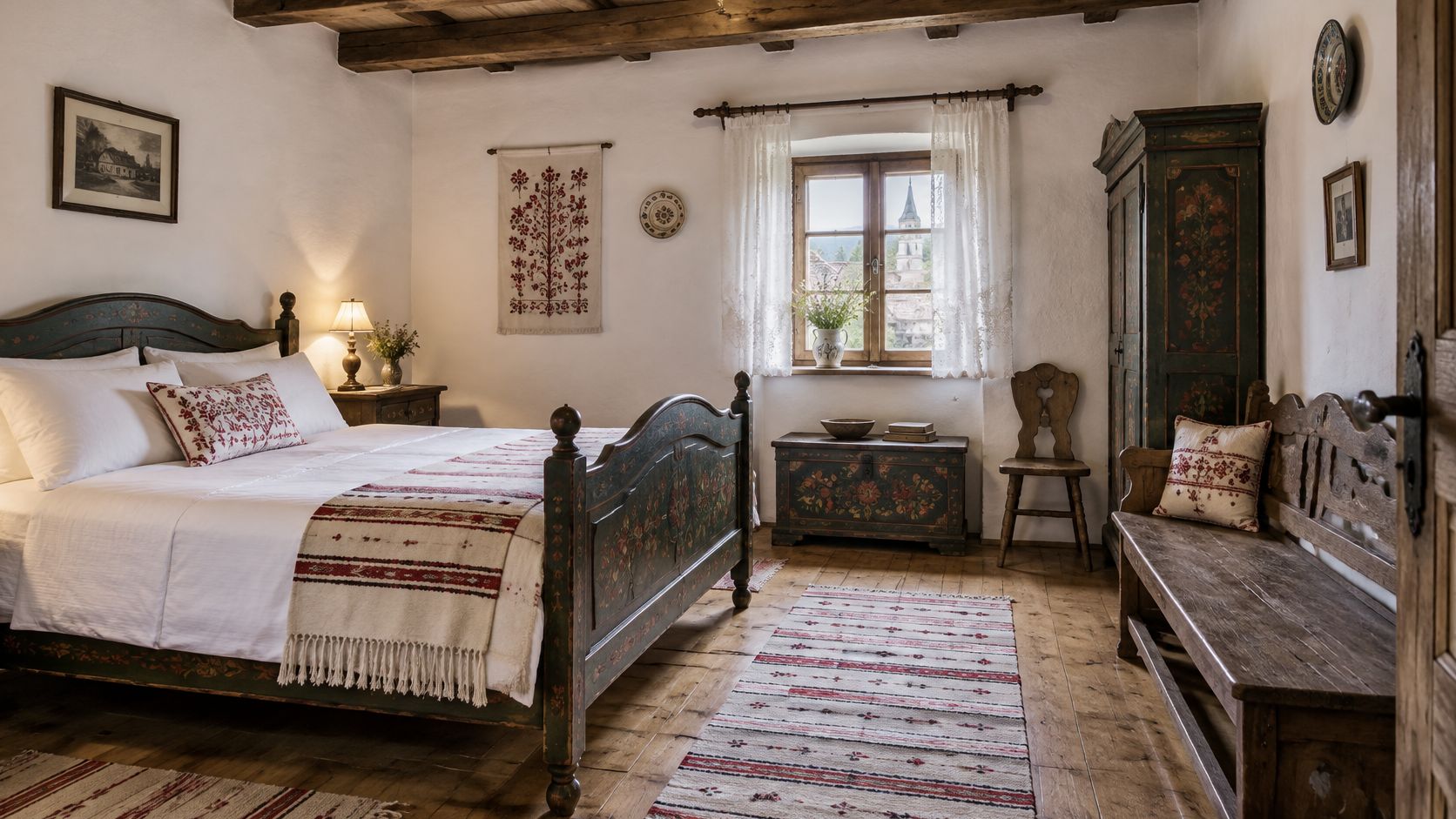
Village accommodation in Micloșoara
The Count's Guesthouses are restored village houses in Micloșoara, also known as Miklósvár, furnished in a traditional style and adapted to modern comfort. Their described interior elements include antique-style furniture, oak beams, plaster walls and antique tiled stoves. These belong to village accommodation, not to an assumed castle stay.
This is the rural application of the field guide. A chair alone doesn't establish the room's character: the exposed timber, wall finish, textiles and heat source matter just as much. Nor does antique-style mean that every furnishing has a verified antique date.
Use the guesthouse room information to begin comparing accommodation, then ask the team which house and room match your needs. For accommodation and riding information, keep enquiries on the main travel site rather than treating an event-venue description as a lodging offer.
Miklósvár Castle and its furnished rooms
Miklósvár Castle is in Micloșoara. Its museum presents furniture with textiles and everyday objects, allowing visitors to understand furnishings as part of domestic life rather than as isolated decorative exhibits.
The estate's Miklósvár Castle events page describes five castle bedrooms, individually furnished with antique furniture and rich fabrics. That description gives a sense of a historic family home, but it isn't a promise that castle bedrooms are currently bookable accommodation. Ask the team about their present use and any access arrangements.
The accompanying video offers another visual reference for considering the setting.
For wedding planning, distinguish the character of a furnished room from its suitability for your gathering. Historic atmosphere doesn't tell you which furniture can be used, moved or included in an event arrangement.
Kőröspatak Castle and practical comfort
Kőröspatak Castle is in Valea Crișului, not Micloșoara. Treat it as an event venue and ask the team which rooms are used and how those spaces are furnished. Don't transfer a description of Miklósvár's collection or bedrooms to this separate property.
Before choosing accommodation or planning an event, resolve practical questions:
- For older guests, ask about seating height, supportive chairs and the effort required to rise.
- For overnight stays, confirm bed-frame suitability and the current sleeping arrangement.
- For mobility needs, describe the person's requirements and ask about the complete route between relevant spaces.
A room can retain its historical character without requiring guests to accept avoidable discomfort. The answer depends on the actual room and current arrangements, not on the style label.
Choosing a Stay or Event Visit
Choose your path according to what you want to do with the setting. Sleeping in a traditionally furnished village house offers time to notice domestic details. Holding a celebration in a castle asks different questions about room use, guest movement and the event arrangements.
Neither experience should be booked on the assumption that all historic spaces are interchangeable. A village guesthouse, a museum interior and a private event room each have their own purpose.
For a village stay
Start with the Count's Guesthouses in Micloșoara if your priority is staying among traditional furnishings. Ask which house and beds are currently available, whether a room's tiled stove is in use and what heating arrangements apply during your visit. A stove's presence doesn't establish that guests operate it.
The guide to rural retreats and holidays can help you place the accommodation within a wider countryside trip. For riding, send the team your experience level and preferred kind of holiday alongside your accommodation enquiry, so they can advise on suitable current options.
During the stay, use the three-part reading method from the Saxon and Szekler discussion. You don't need specialist access to appreciate how a household organised its storage, seating and textiles.
For a wedding or private gathering
Explore Miklósvár Castle celebrations for Micloșoara or Kőröspatak Castle celebrations for Valea Crișului. Keep each venue's furnishing and room-use questions separate.
- Describe the occasion. Tell the team whether you're planning a wedding, anniversary or another private gathering.
- Explain practical needs. Mention mobility requirements, seating concerns and any interest in nearby village accommodation.
- Request a personal offer. Use the private event enquiry form for arrangements made for your celebration.
Public performances follow a different route. Check the public concerts and events calendar rather than using a wedding enquiry to assume concert access.
Confirm access, house rules and comfort details directly before travelling. Older descriptions can help you understand a place, but they can't guarantee current arrangements. The clearest reading of these traditional furniture styles often happens in a working village house, where furniture still has a practical relationship with daily life.
Count Kálnoky's Estates offers heritage guesthouse stays and countryside experiences in Transylvania, with traditionally furnished village houses that give these regional styles a domestic setting. Ask the team to help you choose a house suited to your comfort needs, or to direct your celebration enquiry to the appropriate castle venue.