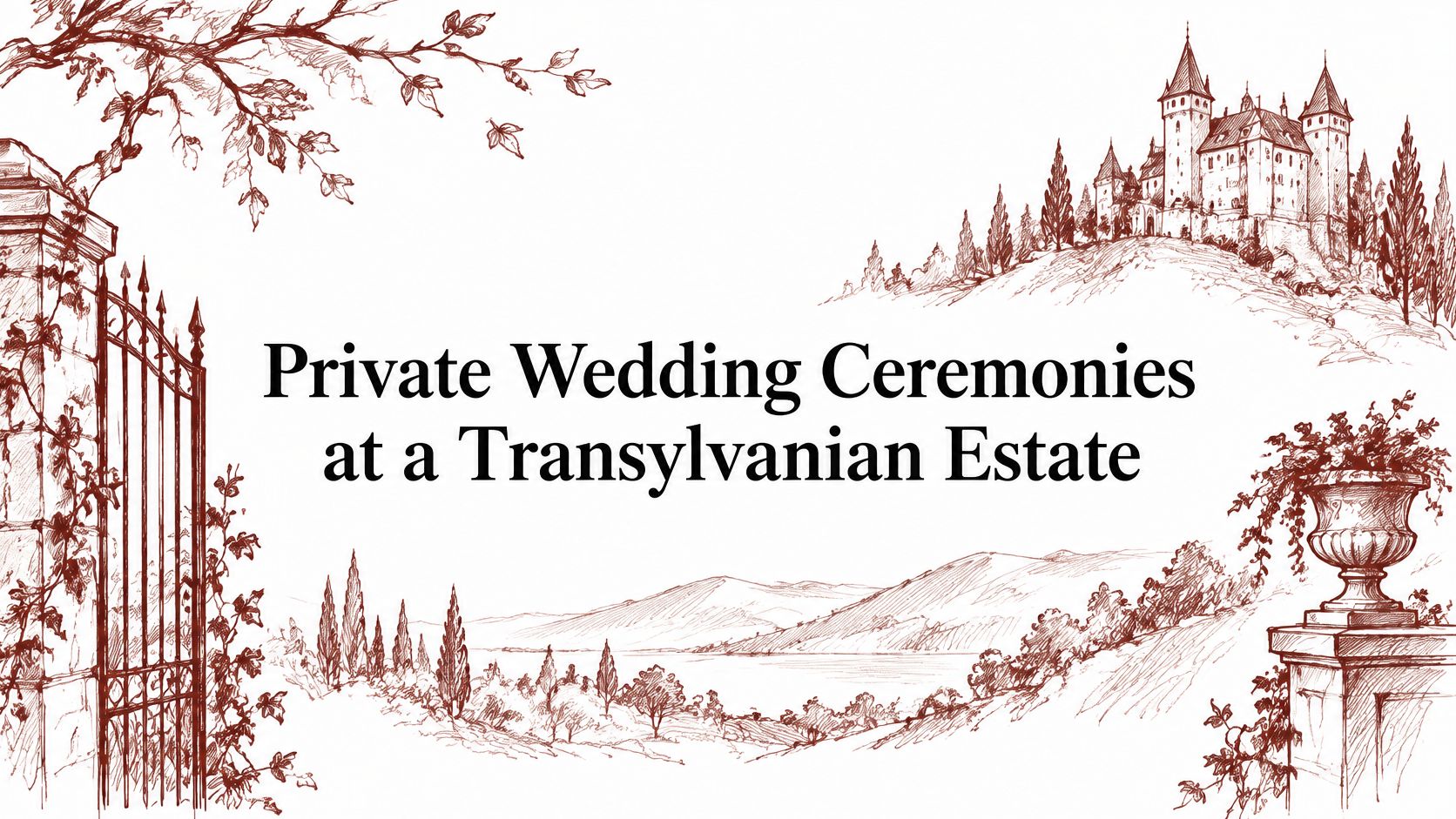
Private Wedding Ceremonies at a Transylvanian Estate
Plan private wedding ceremonies at a historic Transylvanian estate: formats, venue options, weather planning, guest flow and how to book.
You have the venue tabs open on one side of the screen and the guest list on the other, and the two aren't talking to each other. The list says 140. The thing you want says ten people, a stone wall, and a sentence you've been rehearsing in the car.
The wedding industry tends to sell privacy as a headcount: elope, or don't. That misses what most couples are asking for. They want the vows protected and the party open, a quiet room inside a loud weekend.
Privacy is something you build out of layout, timing and weather planning. A package name doesn't provide it, and no venue can hand it to you on the day unless the decisions were made months earlier.
Private Ceremony Formats and Protecting the Vows
A private wedding ceremony is a format, not a headcount. The vows happen in front of a small, chosen group, and the wider celebration runs as a separate event with its own guest list, room and timing. Picture the vows as a protected room inside a larger house. The house can hold the band, the hundred relatives and the long dinner. The room has one door, and you decide who walks through it.
Five formats cover most of what couples book. What changes between them is who stands at the vows, how exposed the moment is, and how much weather can take from you.
| Format | Guests at the vows | Privacy at the vows | Weather dependence | Best fit |
|---|---|---|---|---|
| Private legal ceremony with a later celebration | Couple, officiant, required witnesses | High | Low when held indoors | Couples who want a simple legal moment and a larger party later |
| Private vows before a public ceremony | Couple and officiant, with immediate family nearby | High | Low | Couples who want a personal moment before a wider gathering |
| Intimate garden ceremony | Immediate family and close friends | Medium | High | Couples who want an open-air setting and accept a backup plan |
| Castle courtyard or interior ceremony | Small to mid-sized group | Medium to high | Low to medium | Couples who want historic interiors and cover from weather |
| Livestreamed ceremony | Core guests on site, others remote | Low for remote guests | Medium, since the stream needs a stable connection and power | Couples with distant family who accept an audience |
Read the rows left to right and the tradeoff appears at once. The more people you invite to the vows, the less privacy the moment keeps, so decide the vow group first and the party size second. Most couples do it the other way round and end up negotiating backwards from a seating plan.
The survey evidence points the same way. In a Zola survey of more than 6,000 couples planning 2025 weddings, intimate weddings and small guest lists ranked highly, yet only 6% expected fewer than 50 attendees and just 14% planned weddings under 75 guests, while 78% favored exchanging vows privately. Those answers don't contradict each other. They describe a couple who wants a full house and a closed door.
Deciding the vow group first and the party second
Splitting the legal act from the celebration has a long record behind it. In England and Wales, ceremonies at approved premises grew from a novelty to about 50% of all civil weddings within roughly ten years, and by 2017 they accounted for nearly 70% of all weddings, according to the Cambridge history of the wedding between 1994 and 2020. By 2018 only about 20% of weddings there were classified as religious, against 50% roughly 25 years earlier. The paperwork and the ceremony became separate products, and privacy belongs to the second one.
That's why the family conversation is worth having early and kindly. Explain the vow group as a choice about the moment, not about who matters. Then settle whether guests receive photographs or a recording afterwards, because an unexplained empty courtyard reads as exclusion, while a shared album the same evening reads as generosity.
Protecting the moment on the day
Layout and timing do most of the work:
- Staggered arrival times. Send the wider party to the reception space first and bring the vow group in on a separate schedule, so nobody wanders into the ceremony space early.
- A closed space. Shut the courtyard gate or rope the garden path for the duration of the vows, and put a person on the door rather than a sign.
- Phone and drone rules agreed in advance. State them in the invitation and repeat them at arrival. A drone hovering over the pond undoes a quiet ceremony faster than any guest.
- A supplier brief with waiting positions. Photographers, catering staff and the venue team need somewhere to stand or wait that isn't in the line of sight.
- A decision on photographs. Agree who sees the images, and when.
The test I'd apply: stand where your guests will sit and count the faces you can see. If any of them are people you didn't choose to be there, the room isn't private yet.
Privacy gets designed into layout and timing. It doesn't come from the word "intimate" on a package page.
Legal Steps Before the Date Is Fixed
Privacy is easiest to protect when the legal act is kept small and the vow moment is designed separately. Before you compare a garden to a courtyard, call the local registry office and ask five things:
- Witnesses. How many must attend the legal ceremony, and can they be people already in your vow group?
- Location. Can the legal part be held at the estate, or must it happen at the registry office?
- Documents. What does each partner bring, including certified translations and anything issued abroad?
- Timing. How far in advance must those documents be submitted, and what's the realistic turnaround in wedding season?
- The symbolic follow-on. Can a symbolic ceremony take place at the estate afterwards without changing the legal record?
Write the answers down and carry them into the venue enquiry. A marriage register records the legal act only: who married, where, when, and before which witnesses. It does not measure atmosphere, guest count or whether the promises happened beside a pond or in a town hall office.
Then map the answers onto your chosen format. If the law requires more people than your vow group, hold the legal moment at the registry office and let the estate host the wider gathering plus the private ceremony inside it. If witnesses can come from the vow group, keep them close and give everyone else a later role at the reception.
The first gate: nothing gets reserved until the registry has answered. A deposit paid before that call is a bet on a rule you haven't read.
Choosing Between Miklósvár and Kőröspatak Castle
Two Kálnoky castles sit within easy reach of each other, and they protect the vow moment in different ways. Miklósvár builds privacy out of space and overnight stays. Kőröspatak builds it out of walls and cover. The right choice depends on how enclosed you want the ceremony itself to feel.
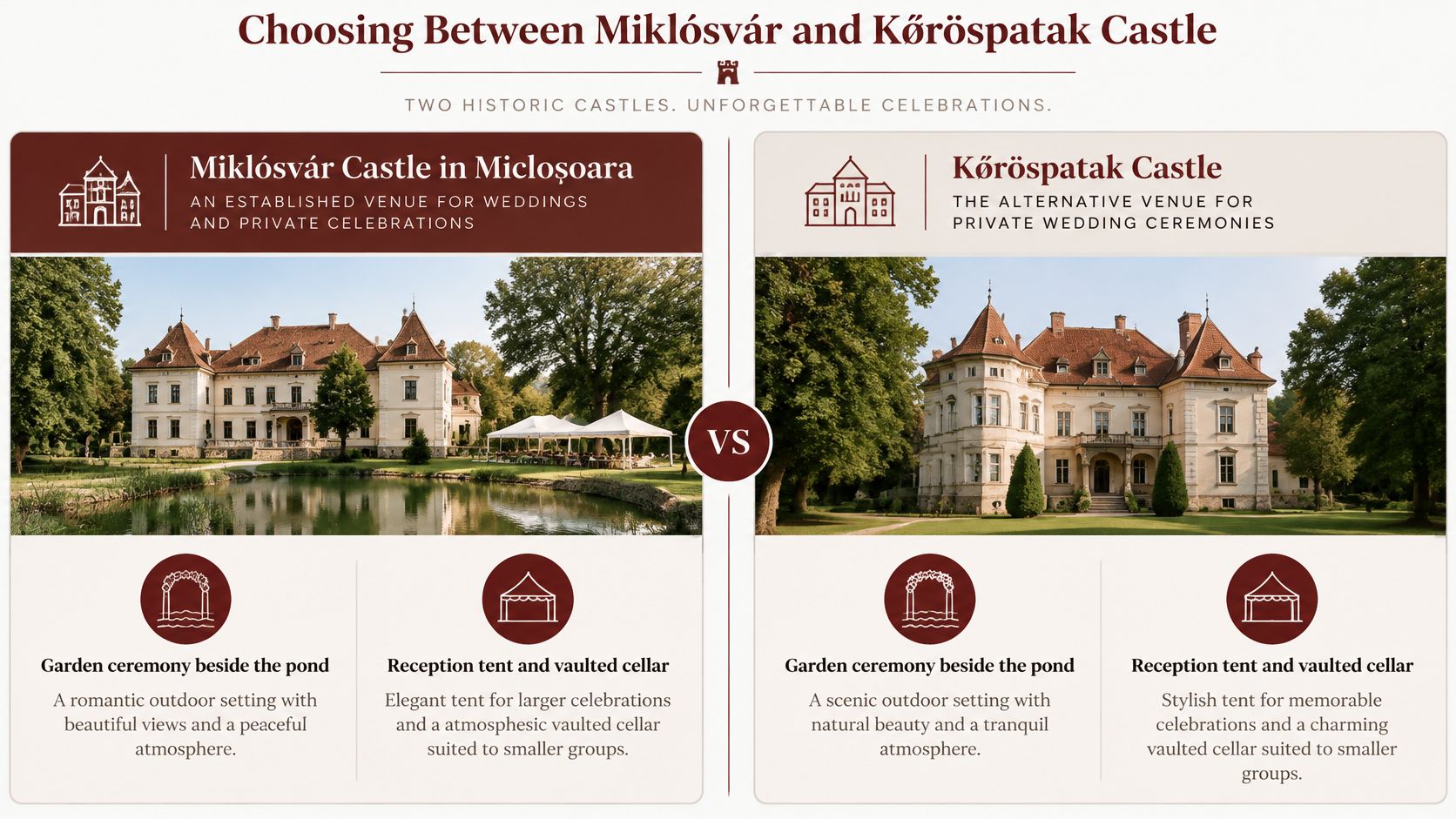
Miklósvár Castle in Micloșoara is the established venue for weddings and private celebrations. Its grounds give you a garden ceremony beside the pond, a reception tent for the party and a vaulted cellar that suits a smaller gathering after the vows. Guests can stay in the village in traditional cottage-style guesthouses, and that arrangement changes the shape of the day: nobody drives home at midnight, the vow group meets again at breakfast, and the private part of the weekend stretches well beyond the ceremony hour.
Kőröspatak Castle in Valea Crișului offers a courtyard, historic interiors and a garden, and its events team confirms which of those spaces is free on a given date. That confirmation matters more than any brochure photograph. For vows that need quiet and cover, the courtyard and interiors do work the garden can't: wind stays off the microphones, guests sit closer, and the vow group reads as one room instead of a scattering on a lawn.
Matching the space to the vows
- Garden and tent suit couples whose vows are open-air by design and whose party is large. You're accepting a weather call, so make sure the covered fallback is held for your date in writing.
- Courtyard or an interior room suits couples who need the vows heard without wind in the microphones, with photographs outdoors afterwards. The trade-off is a fixed capacity, so confirm the seated limit before you fix the guest list.
- The vaulted cellar suits a small group after the ceremony, where the size itself protects the mood. It works best as the evening room for the vow group, not as the main event.
| Venue | Best ceremony style | Ceremony space | Reception space |
|---|---|---|---|
| Miklósvár Castle | Open-air vows and a larger party | Garden beside the pond | Reception tent and vaulted cellar for smaller gatherings |
| Kőröspatak Castle | Quiet vows with cover from weather | Courtyard, historic interiors and garden | Spaces confirmed by the events team per date |
Capacities, layouts and availability are the events team's to confirm for your specific date, and no table settles them. Treat any guest number as unconfirmed until that reply arrives in writing.
The tent and cellar settings look like this in practice:
Planning Weather and Comfort for an Outdoor Vow
Forty guests seated in full sun at three in the afternoon are one thermal problem. The same forty dancing under a tent at ten at night are another. What people feel outdoors comes from the interaction of air temperature, humidity, wind, sun exposure, clothing and how much they are moving, so one forecast reading says very little about the day.
Treat each part of the celebration as a separate load with its own fix.
| Thermal zone | What goes wrong | What fixes it |
|---|---|---|
| Seated ceremony | Guests in formal clothes overheat in direct sun or lose heat in wind | Shade over the seating, a windbreak, water within reach, a covered fallback |
| Tented reception | Still air under canvas, condensation, drooping flowers | Ventilation planned in advance, airflow that doesn't cut across seated guests |
| Dance floor | Sudden heat load once people start moving | Cooler air, a water station close by, a cooler room to step into |
| Evening outdoors | Temperature drops after sunset, lighting fails | Layers on hand, working lighting, a covered indoor option |
Reading the forecast for the ceremony hour
A daily average hides the peak. Record temperature, humidity, wind, sun exposure and rain probability for the specific hour the vows are scheduled, then check again the evening before. Agree with the venue team in advance on the conditions that shorten, move or cancel the outdoor element, so nobody is improvising with guests already seated.
Seating orientation does quiet work here. Angle the rows so guests face away from a low sun and take a prevailing wind on the shoulder rather than in the face. I'd put the shade over the older guests rather than the arrangements, because the people most at risk in heat are the ones least likely to complain.
Sound needs the same on-site testing. Wind and the hard reflective walls of a historic building both strip speech intelligibility, so test microphones and speakers in the actual ceremony layout with someone standing where the back row will sit. If that row misses the vows, the quiet you planned becomes silence for the people it was meant to protect.
Write it down: the wind and rain conditions that move the ceremony indoors, the covered space held for your date, and the name of the person who makes the call.
The objective is continuity. Guests should move from courtyard to garden to tent without a sharp change in temperature, and they should hear every word of a ceremony designed to be quiet.
Questions to Ask the Venue Before You Sign
Put these to the events team on the first call and ask for the answers in writing, inside the booking confirmation rather than a follow-up email you'll lose. Each question exists because something goes wrong without it.
- Capacity in your layout. How many guests fit the ceremony space as you intend to set it, and how many fit the vow space alone with nobody else in sight?
- The covered fallback. Which indoor space is held for the ceremony if rain or wind rules out the garden, and is it reserved for your date or shared with another event? Ask how the switch is triggered, and outdoor reception backup plan questions cover the follow-ups worth pressing on.
- The decision point. At what hour is the relocation or shortened-outdoor decision made, and who makes it: you, your planner, or the venue?
- Sound testing. Will the team test microphones and speakers in the planned layout before the day, and when?
- Access. Which gate, route and step-free path do elderly or mobility-impaired guests use on arrival, and who checks it's clear on the day?
- Staff and suppliers during the vows. Who is on site while the vows happen, and where do they wait?
- Other events on the estate. Are any public concerts or events booked on your date, and are they listed separately from private bookings?
A venue that answers all seven without flinching has done this before. Anything that comes back vague is a question about what a castle wedding venue should confirm in the contract, not in conversation.
Guest Flow, Safety and Booking Sequence
A vow stops being private the moment a lost guest wanders into it. Movement decides whether the people you invited stay inside the moment or drift through it, and on a heritage estate it is usually planned last.
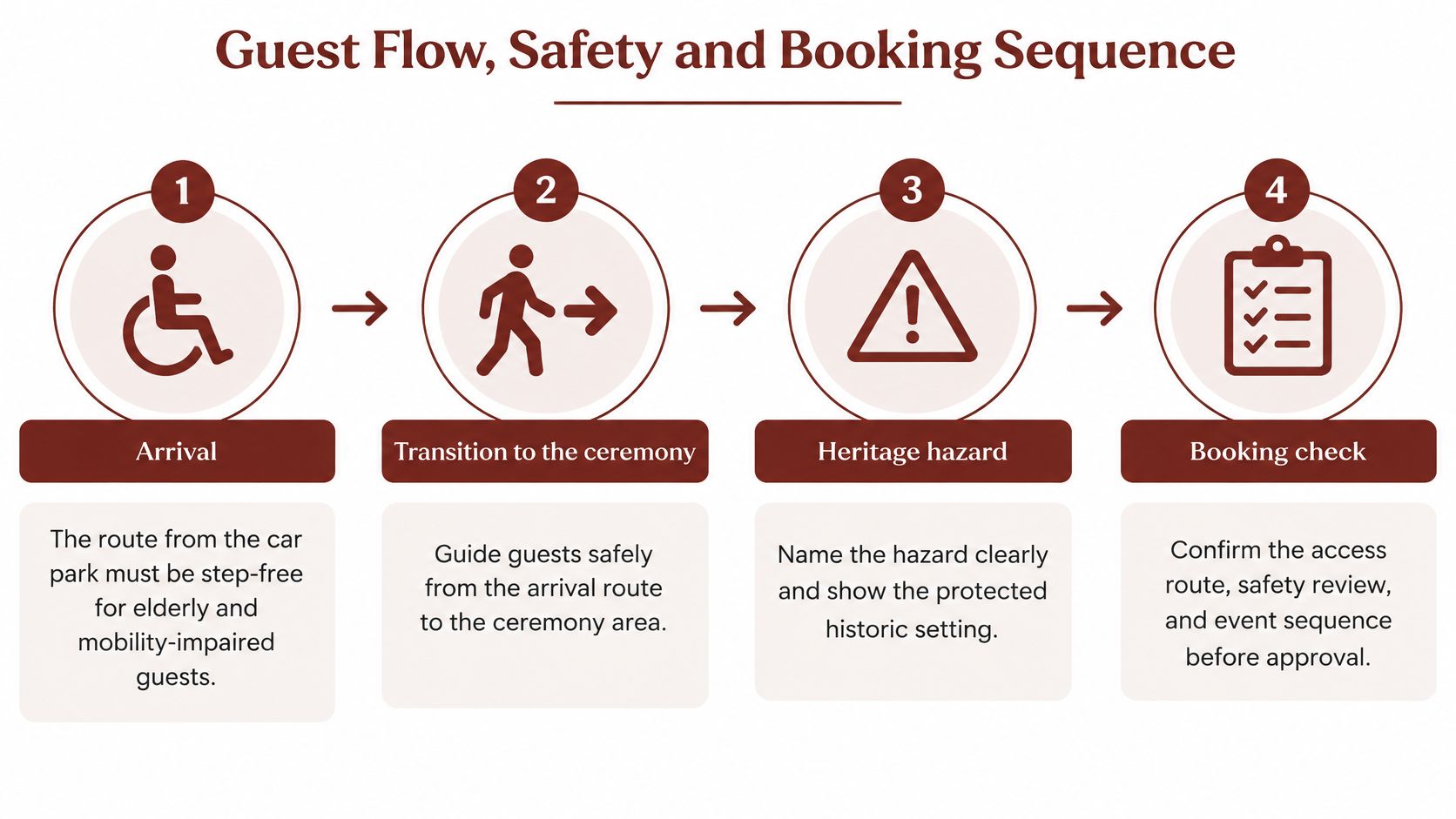
The UK Health and Safety Executive asks organisers to assess how guests arrive, enter, circulate, exit and disperse, and to design the site so people can reach a safe location quickly, in its crowd management guidance for events. A heritage estate makes that harder, because the hazards are scenic: ponds, uneven ground, narrow gateways, historic courtyards and temporary structures that weren't there last week.
The four guest states
Walk them in order and name the check for each.
| Movement state | What to map | Check before the day |
|---|---|---|
| Arrival for the ceremony | Route from car park to ceremony space | Step-free route for elderly and mobility-impaired guests |
| Transition to drinks or dining | Courtyard, garden and tent paths | Guest numbers per path and clear sightlines |
| Normal circulation | Paths around ponds, uneven ground and gateways | Obstacles removed and surfaces checked for the time of day |
| Emergency evacuation | Exit paths and vehicle access | Emergency lighting, a communication method and suppliers briefed |
Arrival is usually the weakest link. The route from the car park has to work for the guests who move slowest: step-free, lit, and watched by someone assigned to it. Route it so latecomers don't cross the view of the vow space on their way in.
The transition to drinks is where bottlenecks form, so count guests per path and make sure a guest standing at the courtyard door can see where to go next.
Normal circulation is about details nobody notices until they trip: a pond edge, a lifted paving stone, a gateway too narrow for two people passing with glasses. Walk the site at the hour the event happens, because a path that reads fine at noon is a different proposition at dusk.
Evacuation is the part that has to be confirmed in writing: unobstructed exit paths, emergency vehicle access, emergency lighting and a public-address method every supplier understands. Temporary structures need experienced suppliers, an inspection after erection and a place on the site plan, plus proper lighting and safe entry and exit for guests.
The booking order that works
- Decide the vow group and how many people stand at the ceremony.
- Pick the format that fits that group and the weather you're willing to accept.
- Shortlist the space, Miklósvár Castle for garden and tent settings or Kőröspatak Castle for courtyard and interiors.
- Submit the wedding enquiry through the estate's events form rather than a general contact address.
- Get the space, layout and date availability confirmed in writing.
- Agree weather thresholds and a covered fallback with the venue.
- Send the movement map and supplier list for approval before the final head count.
The layout feeds everything else. Once the room is fixed, the seating for weddings plan decides sightlines, and sightlines decide whether the back row witnesses a private moment or the back of someone's head. If guests are travelling, the castle hotels in Romania question comes early, because a private ceremony with guests scattered across three villages isn't private for the people trying to find it.
Legal confirmation comes first, the movement plan goes in with the booking, and nothing about the day is settled until the venue replies for your date.
Count Kálnoky's Estates hosts weddings at two venues: Miklósvár Castle, with a garden ceremony setting beside the pond, a reception tent and a vaulted cellar for smaller gatherings, and Kőröspatak Castle, with a courtyard, historic interiors and a garden. Village guesthouses mean the vow group can wake up in the same place. The events team confirms which spaces are available for your date, so list the formats you're weighing and ask for the space, the layout and the covered fallback in writing. Start that enquiry through the wedding and event enquiry form on kalnoky.ro and see both castles before you decide.