Castle Wedding Venue CT: Connecticut Options and Costs
Find a castle wedding venue CT by price, setting and site rules, and learn how Connecticut venues differ from Kálnoky castles in Romania before you book.
Most advice about booking a castle wedding venue CT starts in the wrong place. It tells you to judge the stonework, compare the ballrooms, and book early because Saturdays go first. None of that decides whether a historic property can hold your wedding.
Connecticut's castle venues aren't really separated by how they photograph. They're separated by operational limits: which rooms and grounds you're allowed to use, the occupant load the fire marshal has approved, how many vehicles can reach the door, and what happens to 120 guests when it rains.
Treat the architecture as the last filter, not the first. Below are published prices, the fire-code and compliance questions worth asking before a deposit, and an explanation of why a castle wedding venue CT search also surfaces castles in Transylvania that run on completely different rules.
Connecticut Castle Venues Compared by Price and Setting
The useful comparison is operational: what the venue publishes, what it restricts, and what it leaves unstated.
| Venue | Town or setting | Published wedding price | Price source |
|---|---|---|---|
| Gillette Castle State Park | Connecticut River hills, state park | No wedding price published; rentals are limited to the outdoor terrace on Saturdays from June to September | State park wedding rules |
| Bill Miller's Castle | Branford, Connecticut | Starting at $10,925; average reported spend $26,100 | The Knot (2025) |
| Saint Clements Castle & Marina | Castle and marina setting | $120 off-peak; $155 peak, unit not stated | Zola (2026) |
Gillette Castle is the benchmark a venue brief should be able to match. The 14,000-square-foot stone fortress above the Connecticut River has 24 rooms, was designed by actor and playwright William Hooker Gillette, and took five years to build, from 1914 to 1919, on 122 acres he bought on the hills above the river (Connecticut State Parks). The State of Connecticut bought the castle and grounds in 1943, six years after Gillette's death in 1937.
The detail is checkable, which is the point. The same record notes hand-hewn southern white-oak woodwork, 47 individually designed doors, built-in couches and a table that runs on tracks. A couple can ask any castle for that paper trail.
What to ask for: a designer, a build date, grounds and a purchase date. If a venue can't produce them, you're looking at a themed event space rather than a historic property.
Read the table the same way. Bill Miller's is the only row with a firm entry figure and an average spend attached, so it anchors budget talk. Gillette publishes no wedding price and narrows use to the terrace on summer Saturdays, which trades cost certainty for a hard window. Saint Clements lists numbers without naming the unit, so the quote has to be pinned down before it means anything.
None of this confirms the building hosts weddings with dinner and dancing. A castle listing describes architecture. Capacity, code and site rules decide whether the place works for your date.
Telling Connecticut Castles Apart from Romania's Kálnoky Castles
A search for a castle wedding venue in CT drops Count Kálnoky's Transylvanian estates onto the same results page as the Connecticut properties. Treat them as two separate markets. A Connecticut venue earns its shortlist spot on operational limits: permitted areas, guest caps, fire code and a workable rain plan. The Kálnoky castles sit on a heritage estate in Romania, and their weddings run through the estate's events team at kalnoky.ro.
| Factor | Connecticut castle venues | Kálnoky castles in Romania |
|---|---|---|
| Location | Connecticut, USA; Gillette Castle State Park and Bill Miller's Castle in Branford | Transylvania, Romania; Miklósvár / Micloșoara and Kőröspatak / Valea Crișului |
| Booking route | Through the venue, the state park's wedding rules, or a listing site | Weddings and private events booked through kalnoky.ro |
| Setting | Early twentieth-century estate or landmark castle; river hills or a waterfront marina | Garden ceremony by the pond, reception tent and vaulted cellar at Miklósvár; courtyard, historic interiors and garden at Kőröspatak |
| Guest stays | Not part of the venue; guests book nearby hotels and inns | Village guesthouses in Miklósvár |
Where the two markets diverge in practice
Miklósvár Castle at Micloșoara runs ceremonies in the garden beside the pond, with a reception tent for the meal and a vaulted cellar for smaller gatherings. Kőröspatak Castle at Valea Crișului offers a courtyard, historic interiors and a garden, and its events team confirms which spaces are open on a given date. Guests at Miklósvár can ask about staying in the village guesthouses, which is the one thing a Connecticut venue cannot replicate: lodging is part of the offer, not a list of nearby hotels.
On the Connecticut side, you book directly with the venue, follow the state park's wedding rules at Gillette, or work through a listing site.
Neither set of rules crosses the Atlantic.
Before putting two quotes side by side, run every listing through the same four checks:
- Country and state: a "castle" result can sit in Transylvania, not Connecticut.
- Currency: a euro figure and a dollar figure aren't comparable until converted.
- Unit: per event, per person, per guest, per hour.
- Inclusions: ceremony space, reception space, tables, chairs, staffing.
If your interest in Transylvania is really about staying near a castle rather than booking one, this guide to castle hotels in Romania covers the accommodation side in more detail.
The mix-up costs money in one specific way: a couple sees a small figure next to a large one and assumes the cheaper venue wins. A rate from another country, in another currency, attached to an unstated unit, says nothing until all three are confirmed. Run the checks first, compare second.
What Castle Weddings Cost in Connecticut
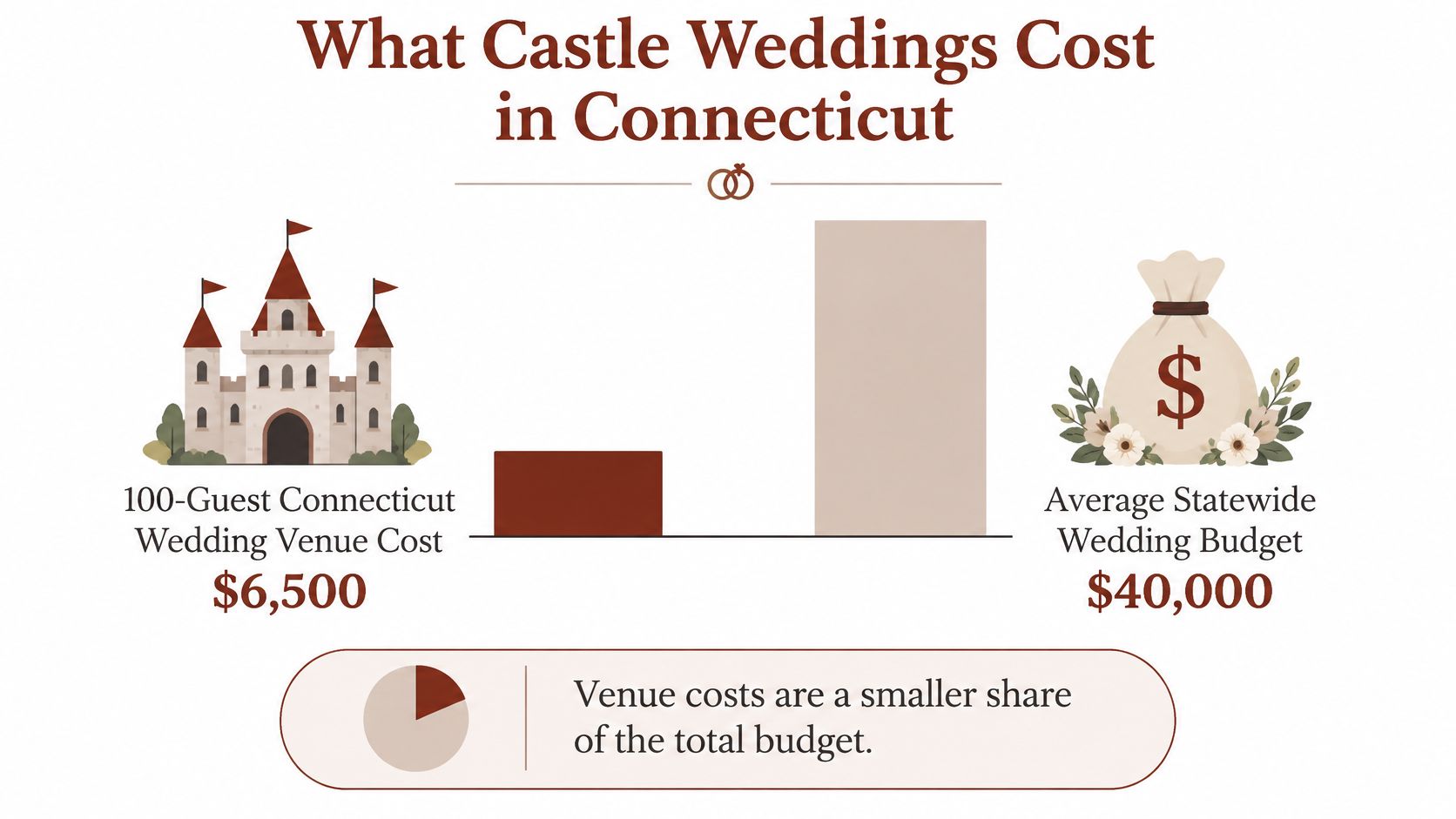
Zola's Connecticut venue page puts the venue line of a 100-guest wedding at about $6,500, against an average statewide wedding budget of about $40,000 (Zola). That's roughly one-sixth of the total on those estimates, and it sets the frame: the building is a minority line item, so a castle fee that looks huge next to a hotel ballroom may still be a small part of what you'll spend.
The Branford listing in the table above shows why the starting price misleads. The advertised fee and the reported average spend sit a long way apart, and every dollar of that gap is catering, rentals, staffing or bar. The listing doesn't say whether the average covers the venue alone or the whole wedding, so read it as a total-spend signal, not a hire fee.
Saint Clements Castle & Marina publishes two rates, one off-peak and one peak, with no unit attached. Per guest, per person on a minimum, or per event are all possible. Until someone at the venue writes the basis down, you can't compare those figures with anything.
Four questions that turn a quote into a budget
What's included. Ask for the line items: tables, chairs, linens, service staff, bar, cake cutting, cleaning, security. A quote that lists them is worth more than one that says "venue hire".
What counts as peak. Peak may mean a Saturday in September, a holiday weekend, or any date in season. Get the calendar in writing, because the difference between an off-peak and peak rate can be the cost of the band.
Tent and rental fees. If the ceremony is outdoors and the rain plan is a tent, find out whether the tent is included, whether the venue requires its own supplier, and whether the lawn can take stakes.
One space or two. A ceremony in the garden and dinner in the hall can mean two setups, two sets of staff hours and two rental orders.
If the total is running past your comfort level, guest photo galleries for budget weddings are a useful reminder that guest count and staffing decisions move the number far more than decor does.
A low starting price often covers the smallest permitted area. If your guest list exceeds that area, the actual cost includes the second space, the tent, and the shuttle, not just the fee you were quoted.
Guest Count Limits Set by Fire Code
Capacity at a Connecticut castle is a life-safety figure, not a sales figure. State regulations classify event spaces by occupancy, require assembly occupancies to have a main entrance and exit, call for exit capacity that supports rapid evacuation, and require an announcement identifying emergency exits once a public gathering passes 100 people (Connecticut eRegulations).
Ask for the approved occupant load of each distinct area, not one number for the whole property:
- Historic rooms: seated and standing capacity, table layout, aisle widths, exit locations.
- Courtyards and lawns: whether the outdoor use changes the occupancy classification or the egress plan.
- Tents: the capacity with the tent up, and whether the tent creates a new assembly space.
- Dining spaces: usable floor area after catering equipment, buffet lines and a dance floor.
Why stone walls shrink a room
A hall that measures 2,000 square feet on a plan doesn't hold 200 people in a castle. Thick masonry walls, narrow stairways, protected interiors and multiple levels constrain how fast people leave, even when the gross floor area looks generous. The number that governs your guest list is the one the fire marshal has approved for that room in that configuration.
Anything that changes the room changes the number. A dance floor removes floor area. A buffet removes more. A tent in the courtyard can shift the space into a different occupancy class and require a fresh egress review, which is why a venue that happily hosts 150 indoors may cap an outdoor reception well below that.
Get the occupant load in writing, per space, before you set the guest count. Doing it afterwards means cutting the list or moving the party.
Before signing, ask whether the local fire marshal has approved the specific layout you're planning, and confirm what your crowd size triggers. A required emergency-exit announcement sounds trivial until nobody has planned who makes it.
How to Verify Code Compliance at a Historic Castle
Preservation status doesn't remove public-safety duties. Connecticut runs formal modification and waiver procedures for building and fire codes, including provisions for historic structures, but applications have to be supported and routed through the local building official or fire marshal to the state authority (Office of the State Building Inspector). Historic buildings are handled case by case through that process.
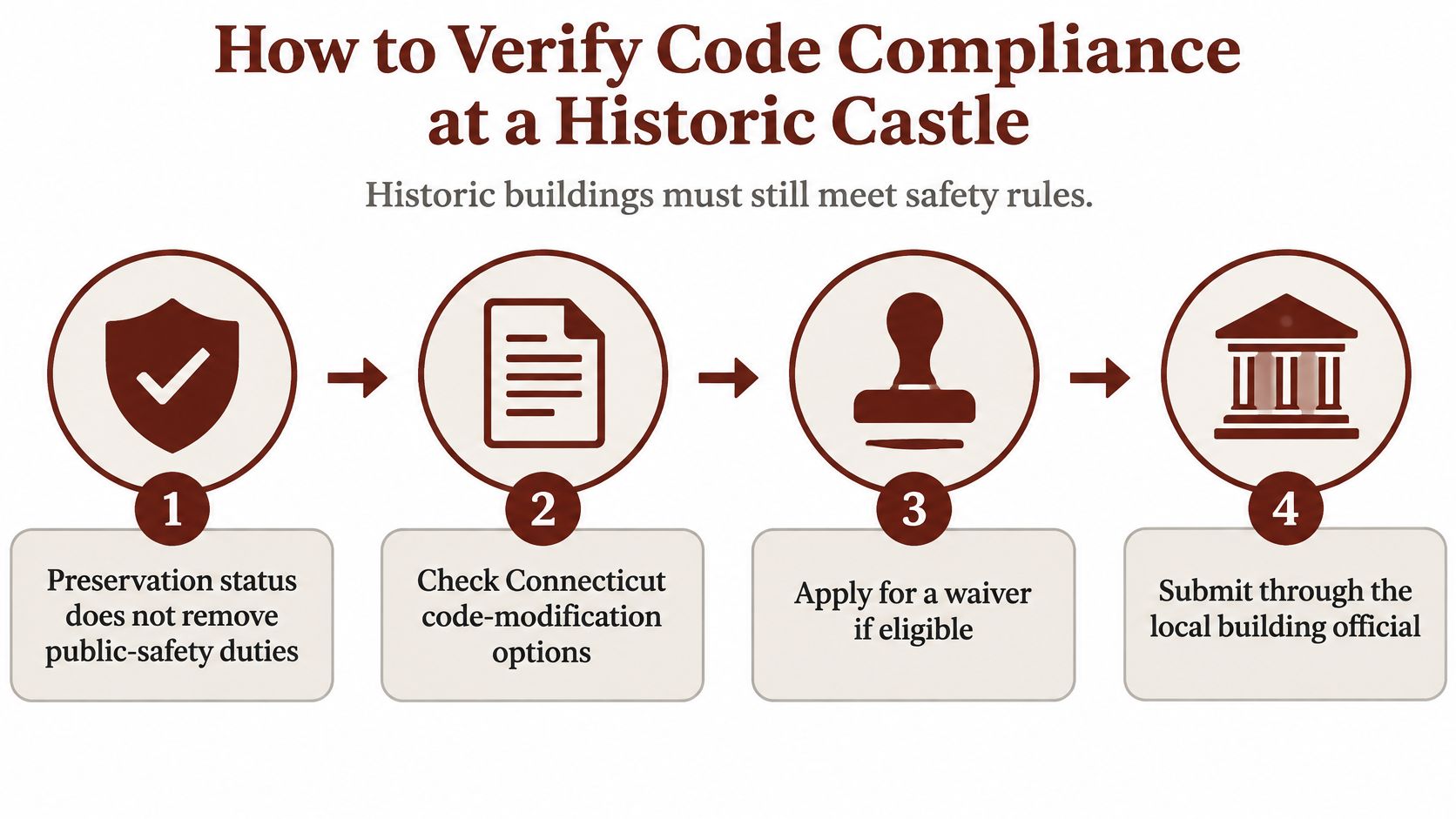
That gives you a sequence to work through, in this order.
Ask for the certificate of occupancy. Check that it covers assembly use and that the use matches what you're planning. A certificate for a museum or a residence is not a certificate for a 150-guest dinner.
Confirm the approved assembly use for each space. The hall, the terrace and the cellar may carry different approvals. Ask which ones are current and which have lapsed.
Trace accessible routes yourself. Walk from ceremony to dining, to toilets, to the emergency exits, and note door widths, thresholds, gravel and stairs. A route that works empty can fail with 100 people on it.
Ask whether any historic-building modification or waiver has been granted, and request the paperwork. A granted waiver is good news. An unmentioned one is a risk, because it may carry conditions on hours, capacity or layout.
Review the temporary elements separately. Tents, generators, candles, propane heaters and mobile kitchens each bring their own fire-separation, fuel-storage, electrical and weather requirements. A venue approved for a seated dinner isn't automatically approved for a tented one with heaters.
Request current inspection records, the approved floor plan, emergency procedures and the vendor restriction list. Vendor restrictions matter most: a required caterer or a banned flame can change your plans and your budget after the deposit clears.
A venue that can produce these documents within a day carries materially lower operational risk than one that answers with its architecture. If you're planning from overseas, collect all six before any deposit becomes nonrefundable, because fixing a code problem from another time zone is close to impossible.
Rain, Access and Site Limits to Check Before You Book
Connecticut wedding-season weather is changeable, and May tends to run wetter than September. Treat rain as a scheduling certainty, not a remote possibility. A venue without a workable backup is an incomplete venue.
Most roundups treat "outdoor" as a look. The useful questions are operational. When is the rain call made, and by whom? Is the backup room included in the fee or billed as an extra? Can a tent go up without damaging historic grounds? And how do elderly guests, wheelchair users, children and anyone in formal shoes get from the ceremony to dinner if the weather turns?
Gillette Castle State Park shows how much a single set of site rules can shape the day.
| Constraint | Gillette Castle rule | What to confirm |
|---|---|---|
| Wedding days | Saturdays only, June through September | Your date and a backup date fall inside the permitted window |
| Permitted space | Outdoor terrace only | Ceremony, dining and restrooms all work on or beside the terrace |
| Guest count | Standing capacity of 50 | Final guest list fits the standing limit |
| Furniture | No additional chairs may be brought | Seating needs are covered by the venue or your plan |
| Vehicles | Three vehicles may drive to the castle | Shuttle or drop-off plan covers guests and vendors |
Those are the published rental conditions for the park (Connecticut State Parks weddings). Read them as a model for the questions to ask at any castle venue: a Saturday-only window, one permitted area, a standing cap well below a typical reception, no outside chairs and a three-vehicle limit at the door. None of that appears in a photo gallery, and all of it decides whether the venue fits your date and your list.
The site walk-through that answers the weather question
Do this on foot, in the rain if you can arrange it. Measure the route from ceremony to dining and from dining to restrooms. Note ramps, cobblestones, gravel, grass and thresholds, and watch where water pools along the path. A route that feels short on a sunny afternoon can become a real problem in wet formalwear.
Then look at shelter between spaces, flooring under any tent, lighting for an early sunset, and how a catering truck gets in and out without crossing the ceremony route. Check whether a shuttle or golf cart can reach the ceremony point and where it turns around. Vendor access is where historic sites break down, because the load-in route was designed for visitors rather than for a van of chairs.
Ask for the rain plan in writing before you treat the venue as booked. A promise made on a tour is not a term.
Choosing Your Connecticut Venue Before You Sign
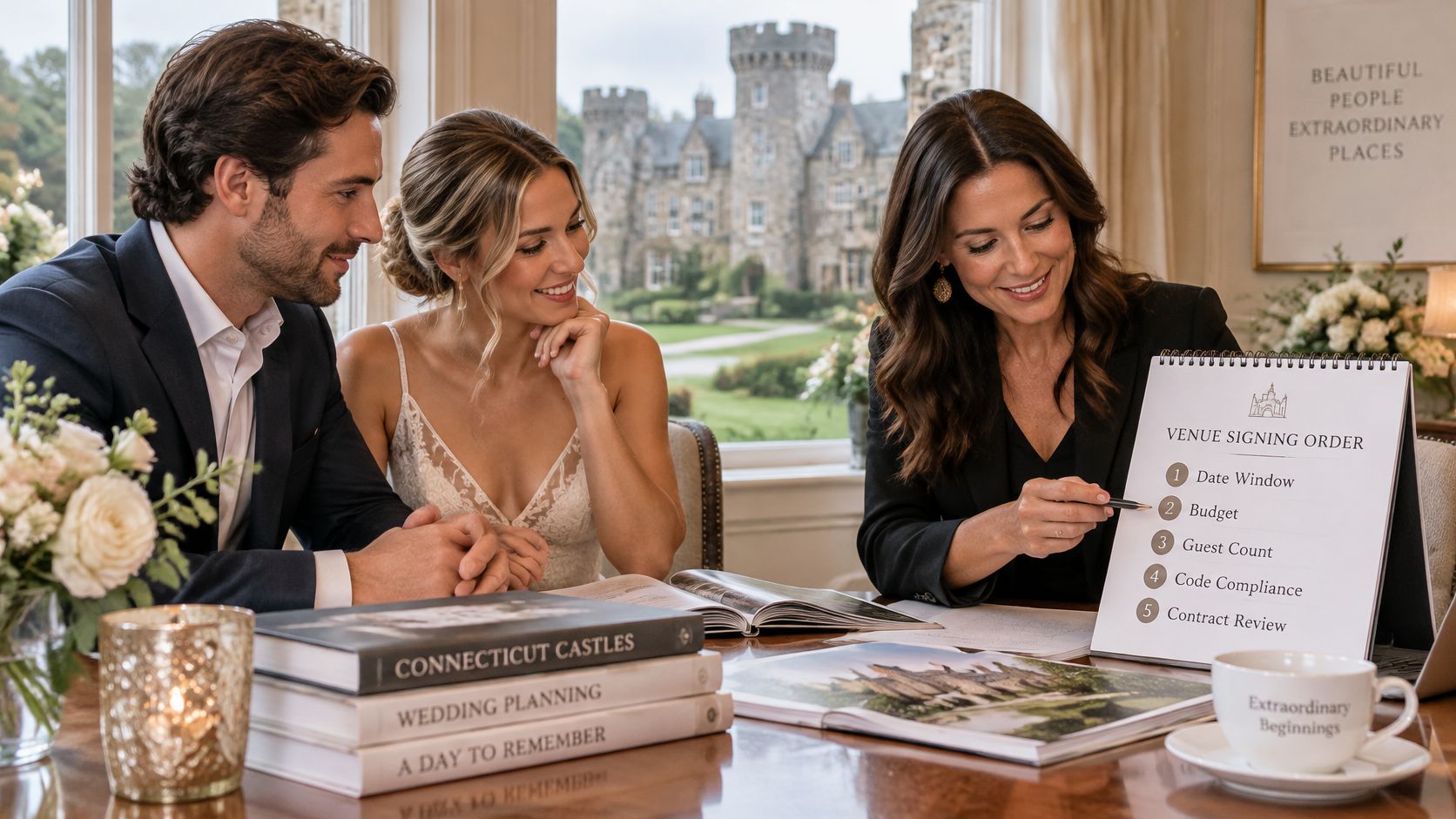
Judge the shortlist by permission, capacity and paperwork. A Connecticut castle wins or loses on operating limits before style enters the decision.
Filter by date window first. A Saturday-only season from June through September can rule a venue out before price matters. Demand is real enough to make off-peak dates worth pricing: wedding.report's 2025 market estimate counted 22,753 weddings in Connecticut.
Get the occupant load in writing for every space you plan to use, including any tent or outdoor area. Set the guest list against that figure, then ask whether the same limit holds when the ceremony, cocktail hour and reception move between rooms.
Compare totals, not fees. Build a written list of extras and decide whether the venue line still leaves room for catering, staffing, rentals and guest transport.
Treat weather fallback as a priced space, not a promise. If the covered area, tent rights or indoor room cannot be named in the agreement, keep shopping.
Collect the paperwork before the deposit. Certificate of occupancy, approved floor plan, inspection records and vendor restrictions should arrive before money changes hands.
Guest travel belongs in that total too. If most of your list is flying into Bradley or a New York airport, price the transfer before you promise a shuttle, and this airport transfer pricing guide gives you the variables that drive the number. A three-vehicle limit at the castle door turns transport from an afterthought into a line item.
Send Connecticut enquiries straight to the venue or the state park that manages the property. Transylvanian enquiries go to a separate team entirely.
Count Kálnoky's Estates opens two Transylvanian castles, Miklósvár and Kőröspatak, for weddings and private celebrations, with garden ceremonies beside the pond, a reception tent and a vaulted cellar for smaller gatherings, plus village guesthouses for travelling guests. Treat it as a separate market with its own enquiry team. Start the conversation at Count Kálnoky's Estates.