Horse Riding Holiday in Transylvania: A Practical Guide
Plan a horse riding holiday in Transylvania: horse types, rider weight limits, multi-day trek pacing and rural stays in the Carpathian foothills.
You have a free week, a photo of open pasture, and a form that asks for your riding level in a single line. It's tempting to either tick "intermediate" and hope, or talk yourself out of the trip. Neither choice helps you or the horse.
A horse riding holiday is a run of days on horseback from a rural base, not a scenic extra on a city break. It holds together only when the horse, your ability, and the ground agree. Breed names and hill views don't make that match. Your weight with the saddle, how recently you rode, and how hard the days stack do.
The choices below follow that order, in plain terms, so you can book with the awkward questions already answered.
Horse Types and Which Rider Each Suits
A typical horse riding holiday here runs for several days from a village base, through pastures, meadows, forest and low hills, with one horse paired to you for the programme. Trail riding is a large part of that market. In 2025, DataIntelo estimated the global equestrian tourism market at $6.5 billion, with trail or progressive riding holidays accounting for 30.0% of spending.
Start with the horse, not the postcard. Build and schooling set what a horse can carry comfortably and where it stays sure-footed, the way a boot's sole sets the ground it grips. The four types below are the ones you'll be offered. Read the columns against your own riding, not against a brochure photo.
| Horse type | Build and temperament | Best for riders who | Terrain fit |
|---|---|---|---|
| Lipizzaner | Compact, strong and calm, with schooling behind it | Want a steady, well-mannered ride | Pastures, meadows and gentle tracks |
| Shagya Arabian | Lighter, athletic build with good stamina | Are comfortable at trot and canter and want longer days | Open meadows and rolling hills |
| Cavalry Gidran | Hardy, sturdy build bred for working stamina | Ride regularly and want a sure-footed, dependable mount | Hills and mixed terrain |
| Hutzul cross | Small, hardy, mountain-bred and sure-footed | Are newer to riding or prefer a relaxed pace | Forest tracks and gentle hills |
Tendencies, not a guarantee
A Lipizzaner is the steady choice when you want manners on pasture and gentle tracks. A Shagya Arabian has the stamina for riders already happy at trot and canter on open meadows and rolling hills. A Cavalry Gidran is the hardy working type for someone who rides regularly on mixed hills. A Hutzul cross stays small and sure-footed on forest tracks and gentle hills, which is why newer riders, and anyone who wants a relaxed pace, often land here.
Two limits apply to every row. Build also sets how much a horse can carry, so your weight with the saddle narrows the shortlist before pace does. And a forgiving horse on gentle ground is still the wrong first ride for an absolute beginner, whose early sessions belong on flat pasture whichever type is under them.
Practical rule: If you can't describe your last three rides, including pace and hours, you're not ready to pick a horse from a photo.
Schooling, age and temperament still differ inside one type. A calm older Arabian can be a better match than a sharp young Lipizzaner, and an unfit horse of any breed fades on a multi-day route. Ask for the individual horse, not only the breed line.
Shortlist one or two types from your real experience, then email the operator with that shortlist and the date of your last ride. Confirm the named horse before you pay a deposit.
Who Can Ride and Which Routes Fit Each Level
The first question is simple. Are absolute beginners accepted, or is this only for people who already canter?
Beginner-friendly on its own isn't a safety description. You can be fine in an arena and still be the wrong person for steep, uneven or remote ground. An experienced rider coming back after a long break can need a different horse too. Mastercard's 2025 European travel analysis reported that 70% of Europeans considered bucket-list activities a top priority, while travel, outdoor activities and dining ranked among leading spending priorities. That demand is why slower programmes exist. It doesn't lower the entry bar on a hillside.
| Rider experience | Suitable terrain | Pace and time in saddle |
|---|---|---|
| Absolute beginner | Flat pasture and meadow tracks | Walk, short sessions |
| Some experience, rarely riding | Gentle hills and open meadows | Walk and trot, moderate sessions |
| Regular rider | Forest tracks and rolling hills | Walk, trot and some canter, full days |
| Experienced rider | Steep, remote and technical routes | Full range of paces, long days |
What still has to be confirmed
The matrix sets terrain and pace. It doesn't replace a written answer on mounting, tack and limits.
- Absolute beginners: Ask if you're accepted at all, whether sessions stay at walk, and how often you mount and dismount. Flat pasture is the only sensible ground.
- Occasional riders: Gentle hills, walk and trot, moderate sessions. Say how long it has been since you last rode.
- Regular riders: Forest tracks, some canter, full days. Still declare a recent injury or a long gap.
- Experienced riders: Steep and remote routes only when emergency access is clear. Skill doesn't cancel fatigue.
A graded matrix should also state hours in the saddle, remoteness, fitness expectations and any riding test before you leave the yard.
If riding has to stop
Tell the operator about medical conditions, past injuries, and any adaptive kit you need. Ask whether a non-riding companion can join a walking or village programme. If confidence drops mid-week, you want the alternative already named, such as a shorter loop, a village day, or a rest.
Helmets and tack should be listed as supplied or not. Weight limits belong in the same email, because they decide the horse.
Matching Rider Weight to Horse Load
Keep the combined rider, saddle and equipment load near or below 20% of the horse's ideal body weight. A research review of ridden load reports that horses ridden at moderate speeds generally show no measurable gait or energetic changes until the rider-to-horse bodyweight ratio exceeds approximately 20 to 25%, though tolerance varies a lot. University of Minnesota guidance in that same body of work treats about 20% as a practical upper benchmark for an average adult light riding horse. Wider loins and a larger cannon-bone circumference are associated with less muscle soreness under load.
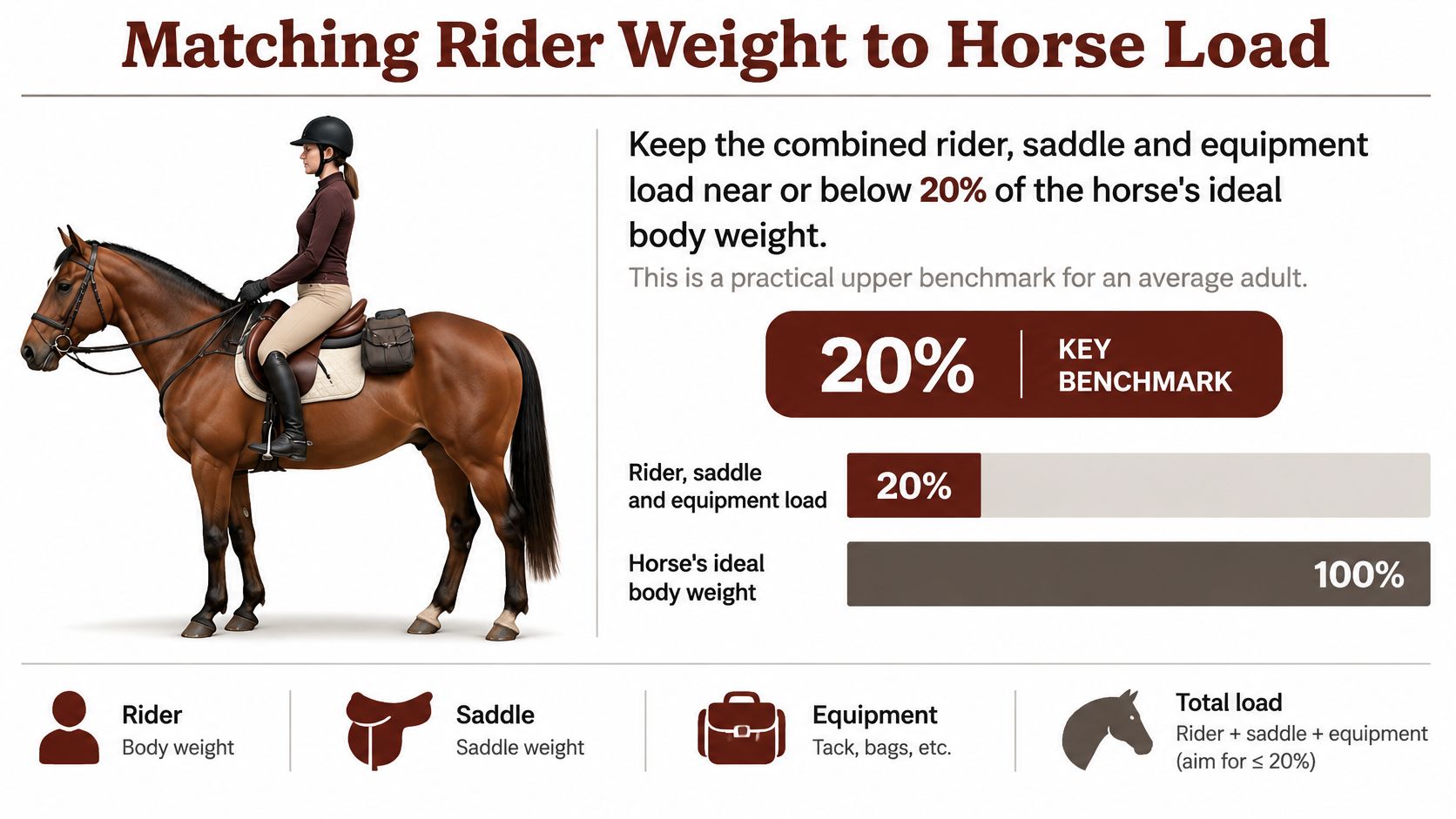
Conformation, fitness, age, soundness, terrain, speed, duration and weather all move the safe figure. The percentage is a ceiling to plan under, not a target to hit.
The arithmetic on common horses
| Horse ideal body weight (kg) | Combined load at 20% (kg) | How to read it |
|---|---|---|
| 350 | 70 | Small riding horse; keep to shorter, flatter days |
| 400 | 80 | Smaller riding horse; keep to shorter, flatter days |
| 500 | 100 | Average light riding horse used as the benchmark reference |
Say you ride at 78 kg and the saddle plus pad is about 10 kg. On a 400 kg horse that combined load sits near 88 kg, over the 80 kg line. On a 500 kg horse the same kit sits under 100 kg. That's why a heavier rider is placed on a larger horse with a wider build, not on a lighter one, and not by height or breed alone.
On hilly forest and pasture routes, uneven footing, climbing, heat and a long day raise demand even when average speed stays low. A load that feels easy on a flat meadow is a different job on a climb.
What to send before they allocate a horse
The yard should take your approximate weight at booking, weigh or estimate saddles and packs, and allocate by body condition, conformation and conditioning.
- Your weight: Give a current figure in the clothes you'll ride in.
- Kit weight: Ask whether the saddle and any daypack sit inside their sum.
- Arrival day: Ask what happens if you're over the limit. A different horse, a shorter route, or no ride are all fair answers.
After a demanding day, checks should cover back sensitivity, gait symmetry, recovery behaviour and delayed soreness before that horse is given another hard day.
A short look at how load sits on the back makes the arithmetic easier to picture before you email a weight.
Countryside Stays and Riding Routes
You arrive in the late afternoon, drop your bags in a restored room, and the next morning the horses are a short walk away. The base decides which tracks you can reach without a long transfer, and whether the week feels like village life or a quiet foothill stay.
A village base at Miklósvár
The Count's Guesthouses and cottages in Miklósvár / Micloșoara sit between the Saxon and Szekler cultural regions. Restored buildings and traditionally furnished rooms put you in a working village rather than a resort strip. From here, day rides use open pastures, meadows, forests and rolling hills. Between rides you can walk the lanes and see how the old buildings were put back into use. Castle stays in the same countryside are set out in this piece on castle hotels in Romania.
Ask whether your week is a single centre with day rides, or a route that changes beds. Ask how far each loop runs from the yard, and what time you leave. Those answers change with the season and the booking.
A quieter foothill option
The King's Retreat, also called the Prince's Retreat, at Zalánpatak / Valea Zălanului is the secluded choice in the Carpathian foothills. You wake to fewer neighbours and a slower start. The same horse types are in use, Lipizzaners, Shagya Arabians, Cavalry Gidrans and Hutzul crosses, with more quiet around the day.
Compare the two bases by the trails they open. If your shortlisted horse is a Hutzul cross for forest tracks, ask which base puts that ground within an easy ride. If you want long meadow canters, ask which base keeps open hills close.
Warm months on those meadows bring horse flies. Pack outdoor skincare and horse fly protection the way you pack gloves, and ask the yard what they already use on the horses so you don't layer on a product they don't want.
Route length, departure times and transfers aren't fixed across the year. Get them from the operator for your dates.
Pacing a Multi-Day Trek Without Overloading Horses
A comfortable first day can hide the strain of the week ahead. Each stage starts from the horse's recovery the night before, not from zero. Heavier carried weight has been associated with increased heart rate, respiratory responses, lactate, rectal temperature, altered stride, gait asymmetry, and possible lameness or back discomfort. How large that effect is depends on load ratio, terrain, intensity, duration and conditioning, as set out in this review of horses under carried load.
Research on carried loads suggests horses can tolerate a moderate load for a day or two, while tolerance drops as work repeats across a trek. Keep the ceiling conservative. Count the rider, saddle and bags together, and remember that a rider who is balanced and well matched to the route asks less of the horse on climbs and descents.
It works like carrying a backpack uphill for several days: the same weight feels different on day four.
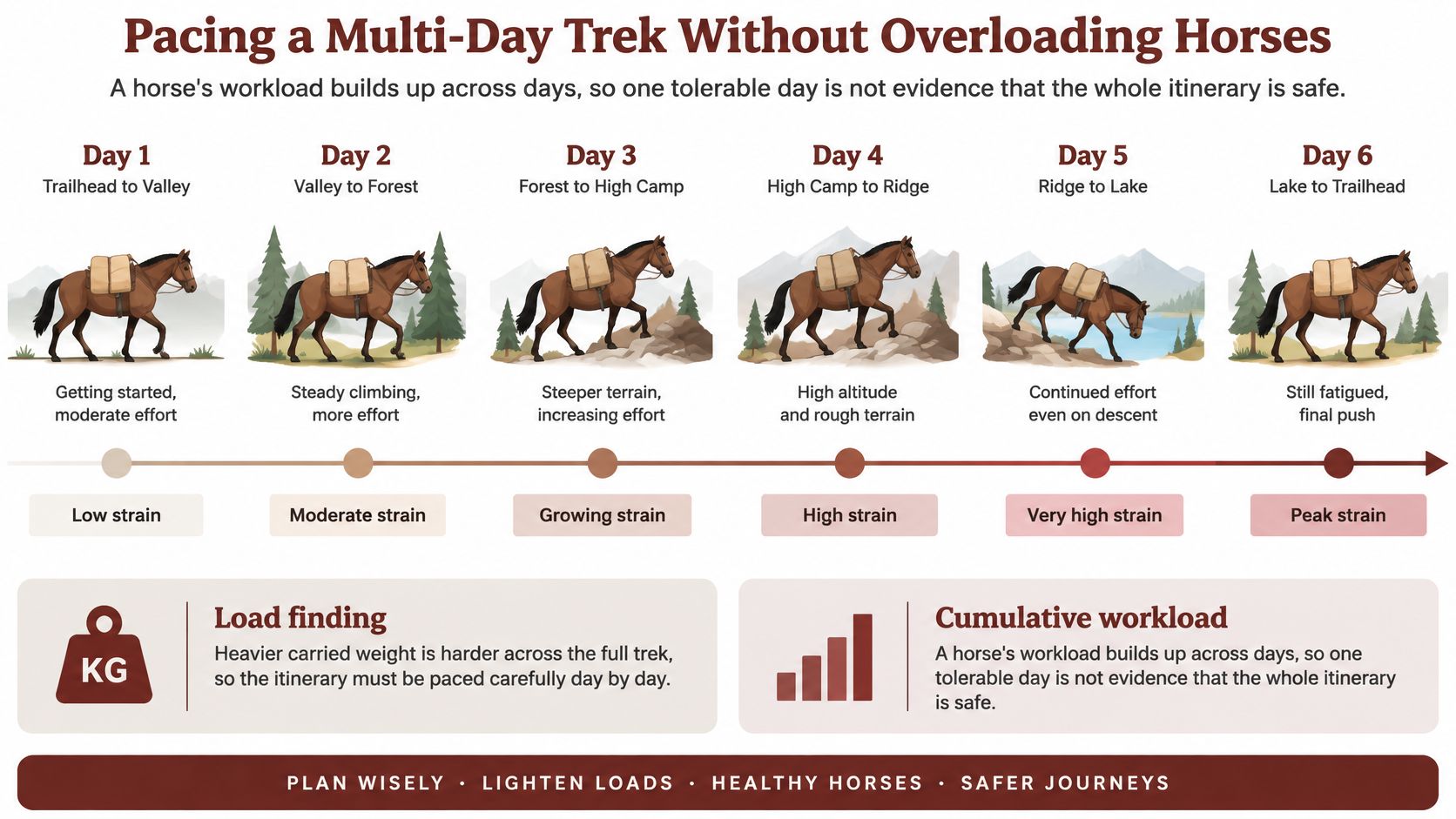
A week that eases in
- Days 1 and 2: Shorter stages and more walking. Adjust the tack and learn the horse during this time.
- Midweek: Longer stages only if the previous evening's recovery was clean. Put a half-day here, before fatigue has built toward the finish.
- Climbs, soft ground, heat and steep descents: Cut speed, and don't add extra kit. A technical descent costs more than a flat trot of the same distance.
- The last full day: Keep it inside what the horse has already done well. A "big finish" is how cumulative fatigue shows up as a sore back.
What a guide should see each evening
Watch heart rate and breathing settle, plus appetite, hydration, stride quality and willingness to move.
- Persistent elevation: Breathing or heart rate that stays high after rest means that horse doesn't go out hard tomorrow.
- A changed gait: Asymmetry or reluctance is a stop, then a veterinary assessment, rather than a wait-and-see at the gate.
- Dull appetite or poor drinking: Treat it as a welfare flag the same evening.
On a hot climb, shorten the stage before you add pace. The horse's recovery that night tells you whether tomorrow should happen.
You should feel the week build gradually. A full riding experience is still there, shaped around the horse's workload rather than the longest possible day.
Seasons, Costs and What Is Included
Nobody honest can quote one price or one daily distance that holds for every week. Route lengths, prices and availability change with the season and the booking. Put the details in writing before you commit.
The list for your enquiry
- Season dates: When riding runs, including any weeks outside summer.
- Shape of the trip: A single base with day rides, or nights that move. Daily route length and departure time.
- Transfers: From the nearest airport or station, and who pays.
- What's in the rate: Helmets, tack, guide fees, meals and accommodation. Ask if the price is per person or per horse.
- Cancellation: What you lose if you cancel, and what happens if the operator cancels for weather or a lame horse.
How heritage stays in this region are set up is covered in this guide to heritage hotels and resorts. Use that for the beds, then keep the riding answers in one email thread.
Ask for dates, daily distance, what the price includes, and the cancellation rule in the same reply. A brochure page isn't a contract.
If a line on the website conflicts with the email, trust the email and save it with your booking.
Responsible Riding and Where Your Money Goes
A remote ride with a small group isn't automatically gentle on the land. The flight or drive in, heavy use of the prettiest tracks, imported feed, energy at the guesthouse and a weak waste system can wipe out the low-impact picture. The footprint works like a feed bill: every line counts, not only the one labelled "horses."
Rider intentions point the same way. In Booking.com's 2025 Sustainable Travel Trends report, 53% of travellers surveyed across 34 countries said they consider tourism's effects on communities and nature, and 69% said they aspire to leave destinations better than they found them. Good intentions are not a welfare policy. They don't shorten a horse's day or widen a rest gap. Ask for the numbers anyway.
Indicators worth a straight answer
Ask how trails are chosen, how welfare is checked each day, and what the maximum daily distances and rest schedules are. A horse's week is cumulative, so five long days back to back load joints and backs the way five consecutive hard runs would load yours. Ask for rider-to-guide ratios, group size limits, trail etiquette, seasonal closures on fragile paths, and how erosion is managed. Then ask where your fee goes, including local jobs, guides, suppliers, and any conservation contribution. A rate that pays local guides and nearby suppliers leaves the route's value in the valley that maintains it.
What you can do as a guest
- Stay longer in fewer places: Fewer transfers, and more of the fee left locally.
- Keep to marked tracks: Especially after rain, when a shortcut cuts the hillside.
- Skip the busiest weeks: So the most photographed loops don't absorb every rider.
- Prefer written rules: If rest days and group caps won't go in an email, treat an eco label as decoration.
Ask how the calendar spreads rides across the year, so one month doesn't carry every hoof.
Confirm Riding Details Before You Book
A booking enquiry works like a saddle fitting: the measurements come before the leather. The yard needs your details before it can name a horse, and you need the route before the dates mean anything. Send them in this order.
- Rate your riding carefully. Match yourself to terrain and pace you can ride. Note medical issues, injuries and any adaptive equipment. If a non-rider is coming, say so now.
- Send weights. Your weight plus the kit you will carry, so the yard can allocate inside its load limit and name a horse, not a breed category.
- Pick the base from the trails. Compare the Miklósvár guesthouses with the King's Retreat at Zalánpatak / Valea Zălanului by which routes each one opens.
- Ask for the pace on paper. Daily distances, where the half-days sit, and what changes if you or a horse is unsuitable that morning.
- Check the match before the dates. Confirm your weight and level produce a named horse and a workable route. Lock dates, route lengths and availability last.
Count Kálnoky's Estates offers guesthouses, rural retreats and riding holidays in Transylvania, Romania. Its riding treks use the Countess's Lipizzaners, Shagya Arabians, Cavalry Gidrans and Hutzul crosses, so it is one place these questions can go. The same questions belong in any operator's inbox.
A good horse riding holiday is built on the right horse and a sensible pace. The longest day you can survive is a poor foundation.
Count Kálnoky's Estates runs heritage guesthouse stays and horse riding holidays across Transylvanian pastures, meadows, forests and hills, with time to match horse, rider and route before you travel. If you're planning that week and want the bases, the horses and the booking details in one place, visit Count Kálnoky's Estates. Send your level, your weight and your dates, and keep their written reply with the booking.
Built with the Outrank app